
As we draw closer to the start of free agency on March 10, I wanted to clear a few things up for the masses since there are a lot of questions out there about the Patriots' spending under the Krafts and how much they might spend this offseason.
Unless you've been living under a rock, you know the Patriots have the most cap space available to them in the entire league, some $120 million effectively (the cap space a team will have after signing at least 51 players and its projected rookie class to its roster) thanks to our friends at OverTheCap.com.
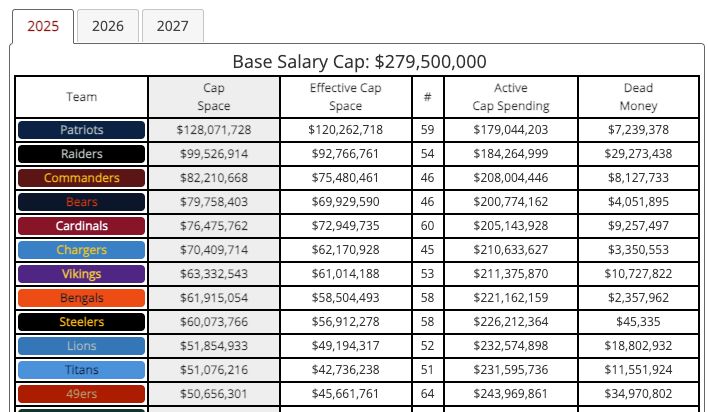
The biggest question I get is: How much should I expect the Patriots to use of this cap space?
My response: I would be surprised if they got past the $100 million mark.
My real response: STOP COUNTING CAP SPACE.
Counting the cap space is the wrong way to keep track of personnel moves from NFL teams. What you want to do is count the cash the Patriots lay out as they go along. That is the ONLY factor. Cash and cap are not the same. Cap space can be manipulated any way you want. You can use a ton now. You can push some down the road.
Cash is the only real thing to owners, especially to the Krafts, who are businessmen first. Every business has a budget, even sports teams. The Krafts use the cap as a guide to their budget each year. It's called being a cash-to-cap team. How do we know this? Well, we've reported it for years, but Robert Kraft confirmed it when he answered my question after Jerod Mayo was fired in January.
Q: Robert, this is going to be very expensive. Buying out a coaching staff, bringing in a new coaching staff, perhaps it goes into the personnel department as well. You also have $120 million in cap space this year, the most in the league. Will what you spend on this transition affect anything that you spend on players this offseason?
RKK: The answer is no. We've always had a situation where we spend to the cap. We have never told any coach or limited the spending. The only thing we've said is if you exceed the cap, we'd like to see it leveled out over three years so that we never get way out of hand. But spending to the cap or above the cap is not ... we want to win. That's our priority first.
So what does that mean for the team's spending? It gives us a good road map for how the team will spend going forward.
I'm not going to get into the argument about whether or not the Krafts are cheap. You can throw out the fact that the Patriots ranked last in the NFL over a 10-year period, but that doesn't tell you everything. Bill Belichick, the man who balked at paying a left tackle in Cleveland more than himself before he posted a winning record, was in charge of much of that. And it also says something about how the Patriots didn't have much drafted internal talent worthy of big-money extensions that most teams use their cash on. Let's also not forget that those 10 years include four years of Cam Newton and Mac Jones at quarterback making nothing. That is going to skew the numbers, which says there is $30 million per year between the Patriots and No. 1 cash king Eagles (who laid out two huge QB deals for Carson Wentz and Jalen Hurts during that time).
I'm going to deal with the recent reality, and that paints a picture of the Patriots basically being in the middle of the league when it comes to cash spending - and I expect them to stay in that area. That's not a bad thing, and neither is being a cash-to-cap team, no matter what talk show hosts say about it.
A lot of people think the Patriots didn't spend much money last year, and used their cap space ($34.9 million rolled over for 2025) as evidence. Again, that's the wrong way to look at it. The Patriots did indeed "burn some cash" last offseason (and tried to burn some more on Calvin Ridley and Brandon Aiyuk) as they were 12th in the league in cash spending
THE CBA CAP FLOOR AND THE PATRIOTS
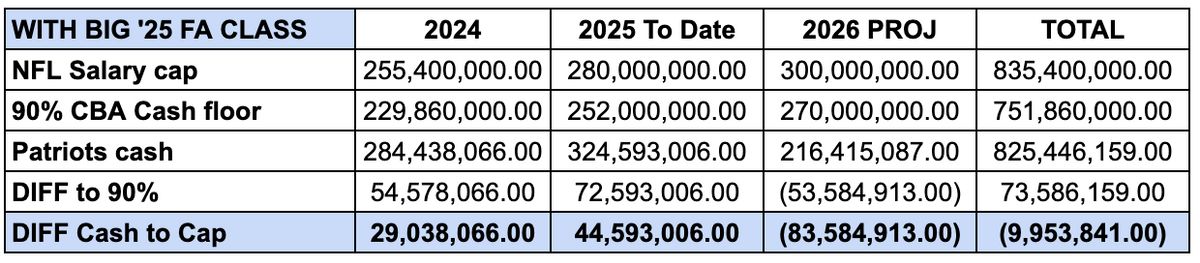
There's been a lot of talk about the cap floor and how the Patriots have to spend more to get there. Reality: the Patriots are already ahead of 90% pace before you even get to this offseason after spending $29 million in cash over cap last year.
The most recent collective bargaining agreement stipulates that each team must spend 90% of the cap in CASH over three years. A new three-year period started in 2024. The previous period ran from 2021 through 2023. Not only did the Patriots meet the 90% threshold, they went well past it.
The cap totaled $615.5 million over three years. The Patriots spent $641.7 million, or 104.26% of the cap.
Basically, they spent to the cap and a little beyond, which goes to them being a cash-to-cap team.
Now we can use 2021-23 as a blueprint for how much to expect out of the Patriots as far as spending.
Let's look at that period via a chart, compare it to the current three-year period, and then show you how that could be used on big-money free agents or trades:
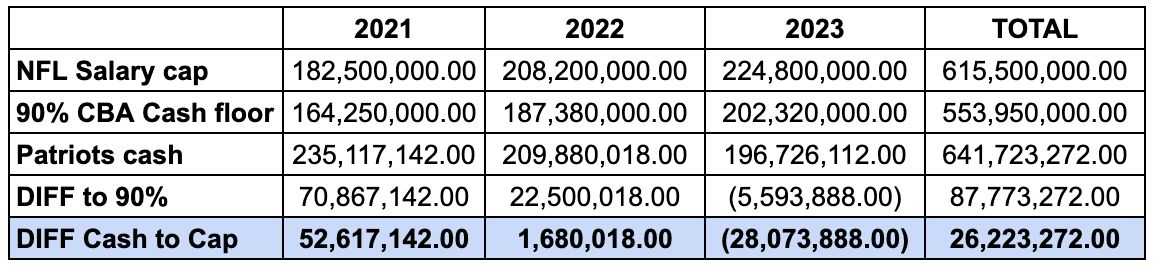
We all know that 2021 was the great Patriots free agent bonanza where they spent on a ton of free agents, including Matthew Judon, Jonnu Smith and Hunter Henry to make up for Belichick's poor drafting.
As you can see on the bottom line, Belichick spent $53 million over his budget in 2021. Like Kraft said, Belichick smoothed out the spending over the next two years relative to the cap: $1.7 million over, and $28 million under. After three years, the Patriots ended up $26 million over their fungible budget.
So let's use that as a guide for the current three-year period:
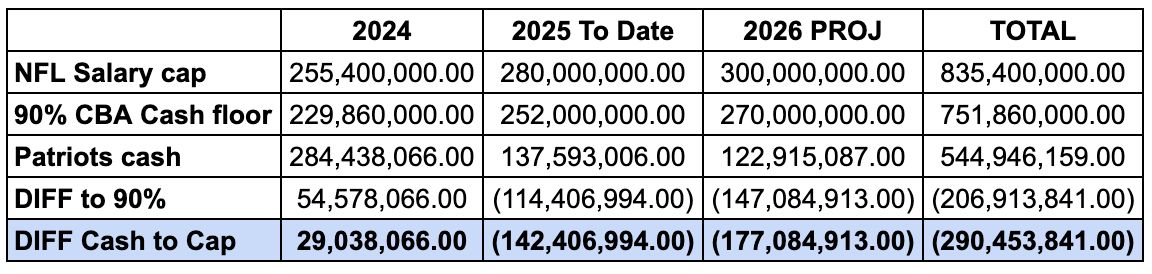
Even though the perception was the Patriots didn't spend last year, they actually spent $29 million over the cap thanks to all the extensions they handed out. If Eliot Wolf landed a receiver, it probably would have been closer to $60 million. Obviously he was OK'd by ownership to do that (that information will come in handy this offseason)
Basically, if the Patriots spent to the cap the next two years, they would end up with the same overage as 2021-23, so that should be the baseline expectation.
Right now, the Patriots have $137.5 million and $122.9 million in committed cash in 2025 and 2026, respectively. That means the Patriots have $290 million in cash to spend over the next two years to meet cap, and $319 million stay over by $29 million.
So that means the Patriots should be expected to spend roughly $160 million in cash each of the next two offseasons. And the Krafts are fine with being over in any one season, as long as it gets offset in 2026.
HOW FAST DOES THAT MONEY GO?
So let's go with a $160 million budget for this offseason.
Something also to keep in mind: like the cap, cash can be utilized in different fashions for accounting purposes. The Patriots could, for example, split up cash payments over two years: $25 million to sign, $25 million 2026 roster bonus if on the roster by the end of the 2025 season.
We have no idea how the Patriots are going to handle such things with a new regime. Prior to this year, the Patriots have been very basic in their contract structures for big contracts. For example, Mike Onwenu got $26 million cash in the first year, $13.5 in Year 2, and $17.5 in Year 3. The Patriots have also been one of the worst teams at utilizing cap mechanisms to maximize competitiveness. Hoping that changes with the new regime.
As far as this offseason goes, keep in mind that having the 4th overall pick (if they don't trade down) will have a big impact. Drake Maye, as the third pick last year, received $24 million in cash in Year 1.
And after looking at the top contracts at positions of need for the Patriots, you can expect to spend at least $25 million in cash for Year 1 - and premium positions like receiver and left tackle (if you can find one, like Ronnie Stanley) will cost more.
Let's say you're the type of fan who wants the Patriots to drink off the top shelf for all their needs. This is what that looks like:
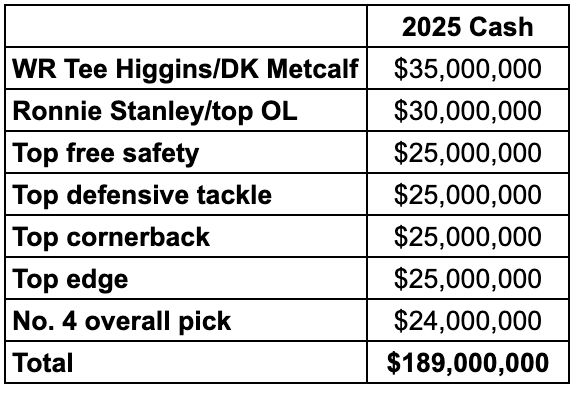
I mean, that's doable ... but you're not going to be able to sign anyone else, so you have to rely on youngsters and draft picks to fill out the rest of the depth chart.
More realistic, where the Patriots get some top-end talent but round out the roster a bit more:
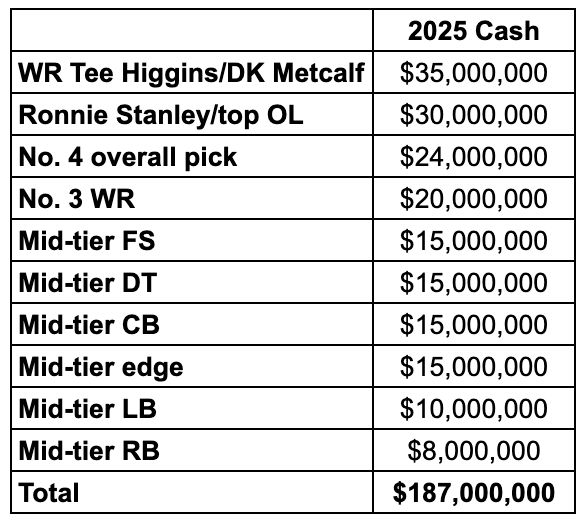
Now, of course, we are not accounting for how much cash will now be added on to 2026, so this is probably a bit of a pipe dream ... but maybe not.
Let's say it's half for the sake of argument. Where does that leave the Patriots at the end of the three-year CBA period? They'd be $10 million under the cash-to-cap budget, so that means they can still add more pieces in 2026.
Hopefully this all makes sense. I'm a little dizzy myself, and I've never been Mr. Numbers (that's Mrs. BSJ) ... but this is the type of math I can normally do.
Bottom line is this: Notice how I never mentioned the cap hits and cap space? That doesn't matter until you have a roster with a lot of talent and you're trying to fit a bunch of pieces together. That's an NFL first-world problem, like with the Eagles or 49ers. The Patriots are a third-world team. All you have to worry about is how much cash they are spending and how quickly.
The Patriots have about $300 million to spend the next two years on top of the players already on the roster for those two seasons (only 32 total signed for 2026).
That's the real scoreboard as they try to rebuild this thing.