
The Celtics offense is a pretty well-oiled machine. When it’s running at maximum efficiency, it’s impossible to stop because there are always so many options.
A common misconception with NBA offenses is that there are either sets or players read and react. The reality is that everything is a read-and-react, either with a simple iso or a pick-and-roll or through a set play. Players are making reads at all times and then reacting from there.
The goal of any set is to help make those reads easier because the defense is manipulated into doing what the offense wants. By setting picks with certain players and certain ways, teams force defenses to do things that open up specific opportunities. Sets sometimes play on defensive tendencies to open up advantages. Sometimes they are specifically designed to create a certain mismatch.
One of Boston’s favorite sets is the horns set, which looks like this:
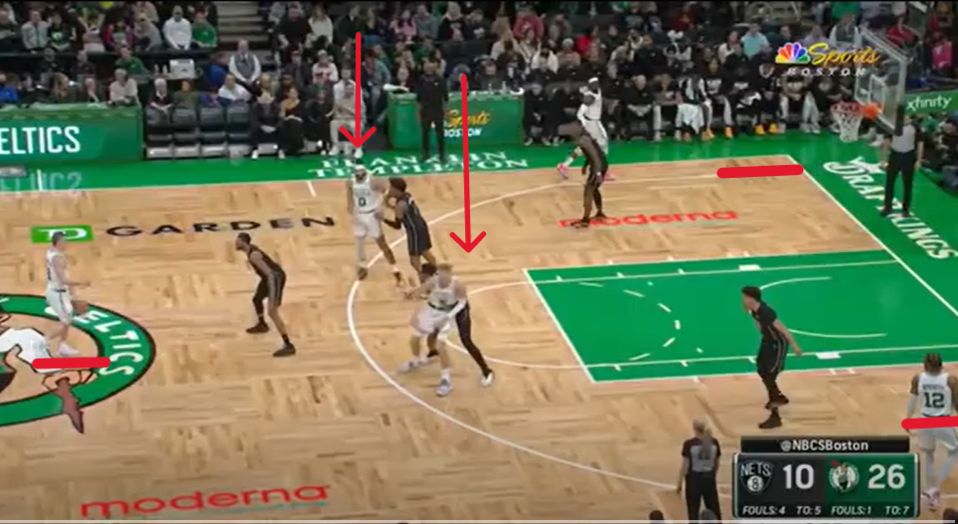
The signature horns set has two pick-setters around each elbow, the point guard at the top, and two spacers in the corners.
Horns is a common set used at all levels of basketball because it causes some confusion with all the possibilities it presents. A team could probably run horns all game long and not get the same shot more than a couple of times.
Boston likes to use it in a bunch of different ways, depending on what they're trying to do. If they run this 10 times in a game, there might be six different sets of screeners and a few different ball handlers. Here’s a glimpse into how they use it.
Joe Mazzulla will use Jayson Tatum as a ball handler or a screener in horns. When he’s screening, he’s often looking for a mismatch for himself. But because everyone knows he’s doing that, the gravity his screen creates often leads to miscommunications on defense.
Tatum sets a good, flat screen to free up Derrick White, who finishes even though the help comes over.
One key element to this play: Where Tatum and Kristaps Porzingis set up matters. Tatum sets up on Payton Pritchard’s side because he’s the shooter in this scenario. Porzingis sets up on Oshae Brissett’s side because he’s getting the pass and Brissett is a non-shooter. Since Brissett is one pass away, the defender has to stay somewhat close and not sag off to help.
If Brissett were on the other side, the help would have been there sooner because no one would worry about that skip pass. Because Pritchard was in the left corner, his defender hung a little longer and it gave White enough time to bobble the ball but still be deep enough to finish anyway.
Those little details can be the key to scoring versus not even getting a shot off.
Here’s the same play with a different path to the same result:
You can see the Hawks' defense is different, with Al Horford’s defender sagging way off. Tatum’s screening angle is wrong as well, which forces White to take a more circular route.
However, that route sucks in Horford’s defender so Porzingis makes the skips pass. Horford then attacks the closeout and White hangs around the baseline, relocating to an open area for a layup.
Same set, different read, different reaction, same result.
Now let’s kick it up a notch:
Same set up, now with Pritchard as the point guard.
Tatum misses the screen entirely because Prichard’s defender dropped to prevent a cut to the basket. That's someone who has seen this play before, so Pritchard reads the opportunity to pop back out to the 3-point line as Tatum reads a pin-down screen.
That doesn’t work, so it flows into a pick-and-roll with Tatum, which leads to a miscommunication as both guys briefly go with Pritchard. Now Porzingis reads this and sets a screen, but because he knows they will have to switch this to recover, he slips the screen and dives to the basket. Tatum hits him with a beauty of a pass, and it’s an easy layup.
The key here is that the play is never truly broken if you keep trying something because the defense will continue to have to react. Tatum whiffed on screens twice but kept at it trying to get the mismatch, which he ultimately did. Porzingis made a great read on the slip and Tatum had his head up the whole time, which led to the quick pass.
Enough of Tatum as a screener. Let’s see Porzingis do it:
Everything looks the same, but now the ball goes to Tatum. The Nets, preparing for a cut to the basket, walk right into a Porzingis screen for Pritchard to catch and shoot.
Read. And. React.
Brooklyn doesn’t want to give up layups off this set? No problem. Pritchard reads the defense and very happily gets behind the screen. He missed, but he won’t miss these often. They’ll take this shot every time.
Now let’s put the ball in Tatum’s hands:
Man, do I love this play.
Now it’s two guards as the screeners because they're hunting mismatches against switching defense. Cam Thomas was targeted a lot by the Celtics in two games against Brooklyn, and this play is part of how they did it.
Good spacing gives Tatum the room he needs. Tatum turns the pick into a seal, and suddenly, he’s posting Thomas up at the nail. Ben Simmons is worried about Sam Hauser’s shooting, so he’s out of the play. On the catch, Tatum can feel where Thomas is on his back so he makes the quick spin for the dunk.
The move was quick and decisive, and Tatum exploded off two feet for the finish. Perfect execution all around.
There are other defensive coverages this set can exploit:
Jaylen Brown is in on the fun now, though he’s here mostly to hold his defender.
Miami is drop coverage so they run the pick-and-pop with Porzingis. Brown makes a move to the basket looking to post up his guy to give White a passing option. When Porzingis attacks the closeout, Brown turns it into a bit of a screen. Porzingis rises up for the easy 15-footer.
Drop coverage immediately creates an imbalance on the floor. There isn't much a team can do to stop Porzingis from getting good looks against it.
How about a couple of double-big looks at the horns set?
They're attacking drop coverage again, this time with Luke Kornet as a screener. They run the play to Hauser’s side so he can hold the corner and prevent help from coming over. Brown is a corner threat, so when White rises up to pass, his defender has to worry about the skip pass.
That gave Kornet a free run to the basket. When White sees that he can see the front of De'Andre Hunter’s jersey, that means he’s out of position to get back to Kornet. As a point guard, once you can see the jersey numbers on your rolling big’s defender in drop coverage, you toss that alley-oop. There's no chance he’ll get back to it.
Porzingis wanted to pop here but the passing lane never materialized. Kornet runs to the rim but nothing is there either.
Once again, when the first thing doesn’t work, you just flow into the next. In this case, Porzingis ends up with Trae Young on him, so that turned into an easy post up. That's a warm-up shot for Porzingis.
And after all this, we can see how Boston will take advantage of teams anticipating horns actions:
Brown goes up to set the scre … SIKE! … it’s a ghost screen. Porzingis sets a flare screen for Brown who now has an advantage. He drives and scores, but that could have become an alley-oop if the defense was played differently or a skip to Hauser on the other side.
Again, sets create advantages, and this one capitalizes on the anticipation that one thing is going to happen because they’ve seen it a few times.
Horns is great because, as you can see, different personnel can shift in and out depending on what advantages Boston is trying to create. Bigs and smalls can set the picks, and just about anyone can be a ball handler depending on what the Celtics are trying to accomplish. It’s also an easy set to spot, so watch for it when the Celtics get back at it tomorrow night and see if you can figure out why certain guys were in certain spots.