
Of all the things that aren't going the Bruins' way right now, the power play is front and center.
Since Jan. 1, the man advantage ranks 27th in the NHL, working at a paltry 15.1 percent clip. It’s even worse in 19 games since Jan. 26, a 3-2 loss at the Tampa Bay Lightning, as Boston has converted on just 10 percent of its man-up opportunities, which sits 31st in the league.
There’s the obvious reference to the 2011 Stanley Cup run that saw Claude Julien’s Bruins go 16.17 percent on the power play in the regular season (below the league average of 18.02) and just 11.4 percent, the third-worst average in the playoffs, beating out the New York Rangers and Pittsburgh Penguins, who were bounced in the first round. The league average in the 2011 playoffs was 18.8 percent, and Boston managed to win against formidable power plays like Tampa Bay (25), Montreal (22.2) and Vancouver (20.4). I digress.
On this season as a whole, the NHL average power play is 21.2 percent. Going into the January loss at Tampa, the Bruins ranked second with a 27.2 percent power play (they were fourth-highest at 27.6 before the calendar flipped to 2023).
“Our power play has kind of stalled,” Jim Montgomery said on March 8. “It’s been flat, right? If you look at the Bergeron unit, they’ve scored two goals over the last however many games. Only one goal was really an in-zone goal, and it was [Jake] DeBrusk’s first game back from injury [against the Islanders on Feb. 18].”
So, what gives?
Part of it is the slip in details in Boston’s overall game, which has invaded the once automatic power play.
Other than pride, individual glory or regular season records, the Bruins don’t have a ton to play for right now. Concerning, yes, but it could explain why they couldn’t get up for a Tuesday night against lowly Chicago. The B’s have said that the regular season accolades don’t mean much, so instead, they’ve created their own motivation, treating their previous road trip almost like a playoff series and breaking it into segments.
If that was the plan on the current road swing, Boston has quickly found itself with work to do in the series. Either way, the ball is now in Montgomery’s court to rediscover the motivation, and with that, will likely come better overall execution, which should trickle down to the power play. Perhaps it’s already started, as his postgame comments were as brief and poignant as we’ve heard all season.
“I mean maybe [it’s a mental focus thing]. … Now it’s two stretches that we haven’t had it,” Montgomery told reporters in Chicago. “First one, I thought it was physical fatigue. This one, there’s no reason for physical fatigue, and we look like we’re tired.”
In his postgame NESN interview, Montgomery said, “Frustration, mostly frustration. You know, we’re not working as a team right now, and it’s the first time all year that I can say that. I just know that the energy and emotion of our team right now is very, very… at levels I haven’t seen all year.”
Another explanation is opposing penalty kills may simply be executing a better blueprint to neutralize the Bruins’ attack in man-up situations.
Boston’s go-to looks on the top power play are one-timers for David Pastrnak on the elbow or Patrice Bergeron in the high slot, or “bumper.” When those aren’t there, it creates problems. Part of what has helped penalty kills find success over the last few seasons is closing down the passing lanes to Bergeron and Pastrnak, and having the high forward close on the puck carrier quickly to force a hasty decision. Usually, the Bruins can make decisions quickly, but the puck movement and motion away from the puck have stagnated throughout this latest slump. The Blackhawks were excellent at exploiting those weaknesses on Tuesday.
Take the below film from the B’s first power play in Chicago as a sort of Exhibit A for what has plagued the top unit.
Going through the power plays from the other night. Good job by Chicago here exploiting what happens when a crutch option like Bergeron is taken away. Look how quickly they close the option to him. It eventually leads to a good look for Pastrnak at the end. pic.twitter.com/usJ3lvBC10
— Patrick Donnelly (@PatDonn12) March 16, 2023
Bergeron loses the face-off, so Boston can’t set up and is quickly in a frenzy. Boris Katchouk is all over Pastrnak and Bergeron as they try to settle things down along the boards at the left point.
They settle it down as Dmitry Orlov gets the puck to Brad Marchand, but look how quickly Seth Jones and Philipp Kurashev close down the passing lane to Bergeron.
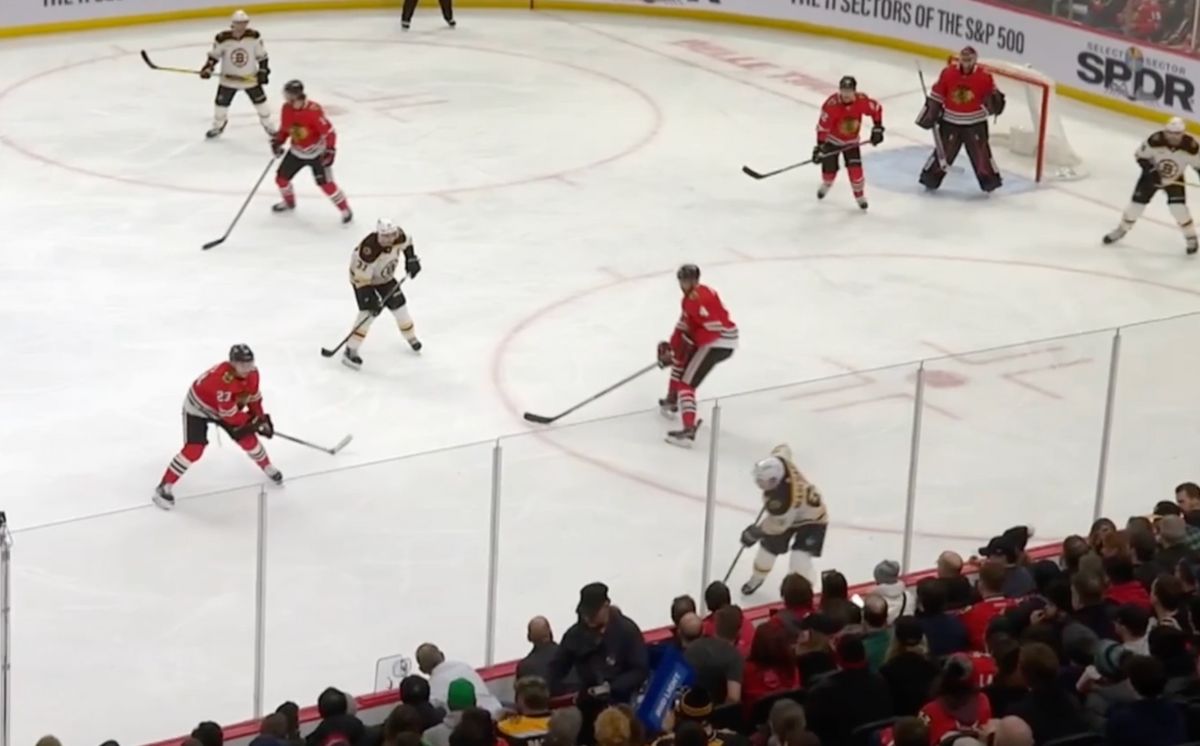
Marchand gives back to Orlov, who settles for a shot into the pads in front of him as Pastrnak is without a good shooting angle. He gets it back and gives it to Pastrnak, again without a good look for a one-timer. He settles for a wrist shot (blocked) before forcing a pass to Marchand (also blocked).
Orlov works the puck back to Marchand, but again look how quickly Jones and now Katchouk close down on Bergeron. Marchand forces it twice. First to Bergeron, who gives it right back, then tries to go across to Pastrnak, which never makes it through.
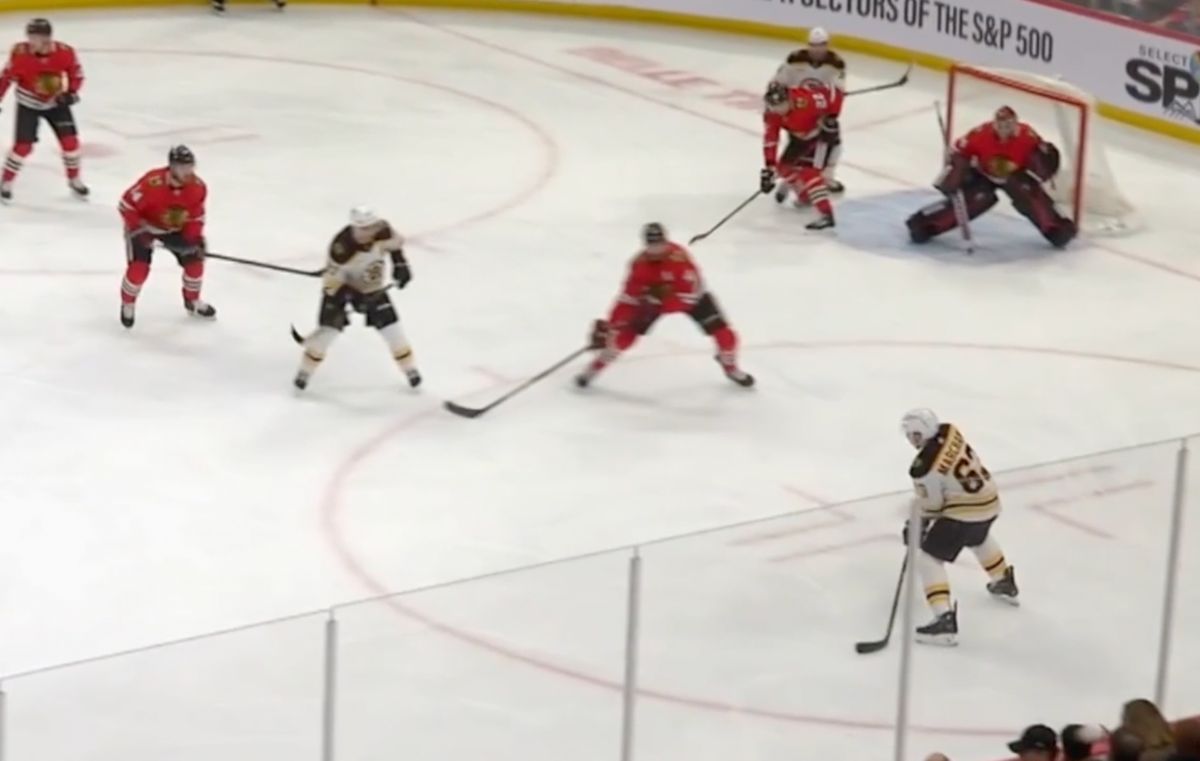
“I think right now, we’re disconnected,” Bergeron said. “We’re not playing the right way. We’re cheating. I think this league is going to humble you if you do that. So, I think that’s what we’re getting right now. I think for us, like we’ve done all year, we need to look at ourselves in the mirror. We know that it’s not good enough, and we need to go back to what’s successful for us and what’s been good to us all year. A lot of things that we can learn from these last couple games.”
Although, the unit’s best look on that opportunity came at the tail end of the clip. Watch how three Blackhawks go to take away Bergeron. Tyler Bertuzzi sees that and slides into the open space to the right of the net. Now, there’s a better lane open to feed Pastrnak. Even though Connor Murphy blocks the one-timer, it’s still a good look from that position.
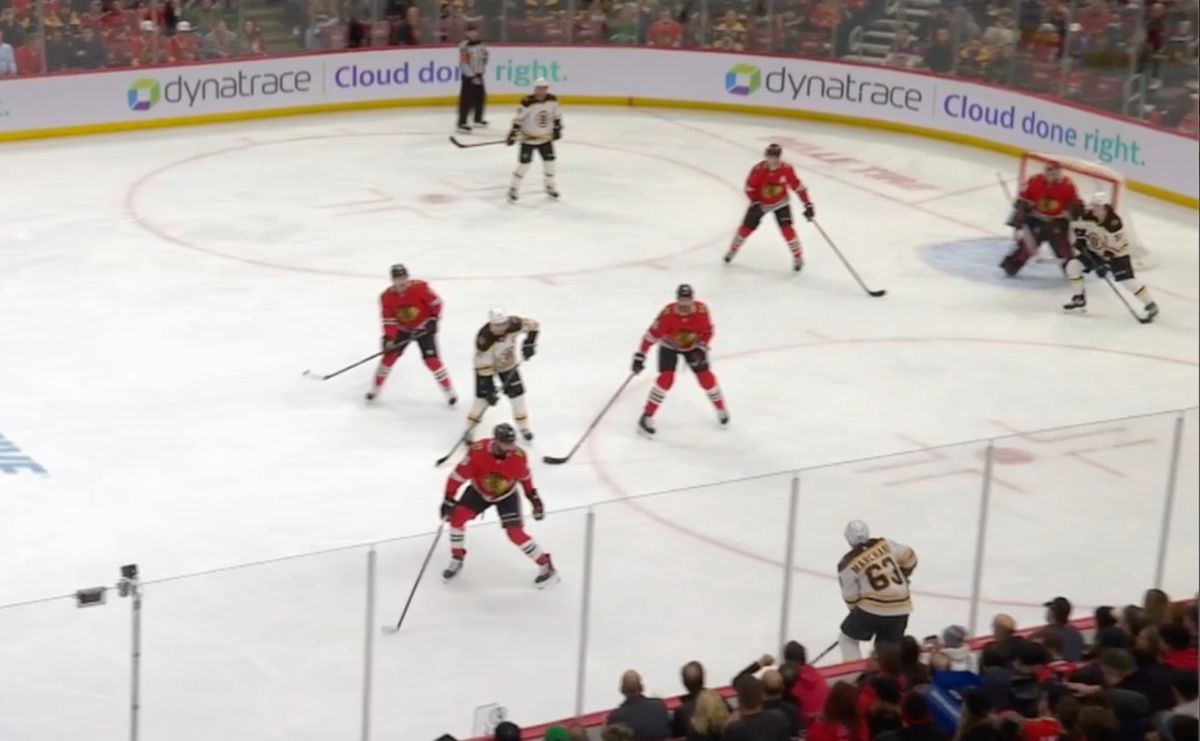
Let’s look at what has made the second unit (moderately) successful lately.
First, here’s Bertuzzi’s almost-goal in Chicago.
Here's part of why the second unit has been barely more successful. Zacha doesn't force anything after entry. Knows Krejci is on the other side, rims it around. Bertuzzi doesn't force when there's no shot. Curls, stays in motion. Shot threat for Orlov opens the lane for Bertuzzi. pic.twitter.com/f9D2W3ohrM
— Patrick Donnelly (@PatDonn12) March 16, 2023
Pavel Zacha and David Krejci are quicker with the puck when facing pressure. Upon entry, Zacha doesn’t force anything, and sends it around the boards where he knows Krejci is waiting. Krejci bumps it to Orlov, who moves it to Bertuzzi.
Bertuzzi closes down the wing and does not force a shot or a pass when he sees there is nothing there. He reverses back to Orlov, but the key is he stays in motion.
Jujhar Khaira (not nearly as aggressive as Katchouk or Kurashev) focuses on Orlov to take away a shooting lane. More on Orlov’s value at the top in a second. That gives Bertuzzi the entire left side of the zone as he curls around. He walks into the shooting lane and rips it, coming millimeters away from tying it.
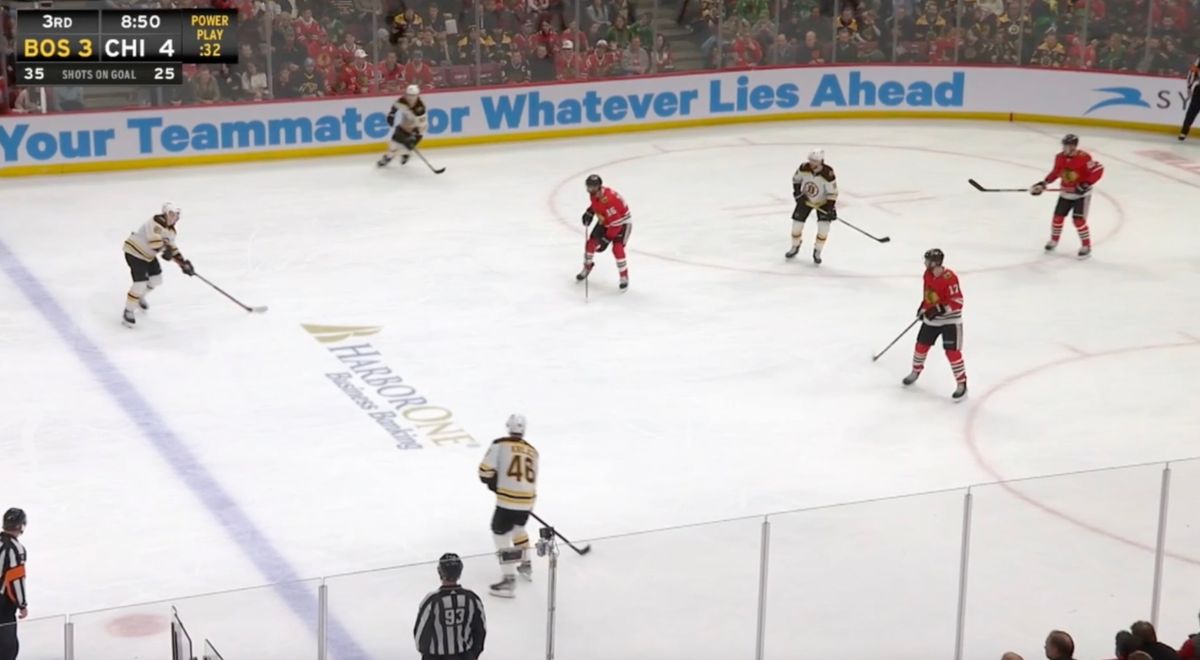
Now, here’s a look at Krejci’s waved-off goal last Thursday in the loss to Edmonton.
DAVID KREJCI KNEE DROP ONE TIMER pic.twitter.com/KnHRtKBL9T
— Spoked Z (@SpokedZ) March 10, 2023
The Bruins move it quickly around the perimeter. Krejci moves it back to Hampus Lindholm up top, another shooting option, and Connor McDavid has to jump out to try to block the shot.
Lindholm fakes and zips it to Charlie McAvoy. Watch Zacha in the middle. It’s not much, but he drifts towards McAvoy.
While McDavid is essentially out of the play, three Oilers close on Zacha to clog the middle and take him away, which opens the passing lane to Krejci for a one-timer.
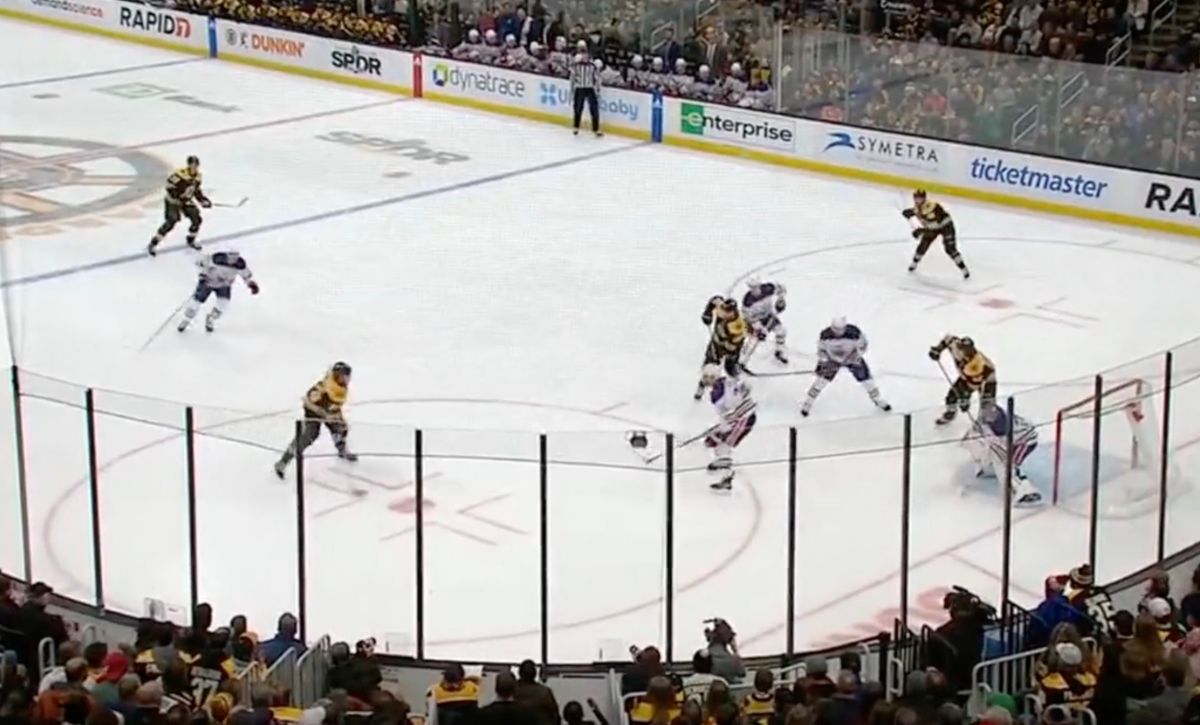
The goal was waved off due to an offside by inches 30 seconds earlier, but it shows the importance of quick puck movement and motion to Boston’s power play, creating chaos for opposing defenses.
A third facet of the struggles could be simply finding the right mix. Whether it’s moving Orlov to the top unit or McAvoy to the second.
“We have the opportunity to experiment, so we’re experimenting,” Montgomery said last Wednesday.
McAvoy seems to have found a good spot on the flank of the second power play unit. Offensively, he excels from the face-off circles on down. His vision from that spot is on display on Krejci’s close call, and he has been effective when burrowing down the right side of the zone.
Montgomery said on March 8, “We’re also looking at, how does Charlie McAvoy have a lot of success? He has a lot of success attacking down the right wing in the offensive zone. If you look at all the plays he makes, the last game [against the New York Rangers], he comes down the right wing, gets the pass, toe drag and over for a one-timer. He’s a real dynamic player on the move, and we want to put him in situations where he can succeed and make us better.
“Ultimately, it’s how can we try to experiment to make the Bruins better?”
Even if it hasn’t necessarily clicked immediately, part of that experiment is Orlov quarterbacking the top power play.
“It’s something we’re going to have to continue to work on, but he sees the ice really well,” Marchand said after the March 9 loss to Edmonton. “Moves along the line really well. Really smart player, so I’m sure it’s going to work.”
Montgomery has praised Orlov’s shot and one-timer since coming over in the trade from Washington. The Russian may unofficially have one of the hardest one-timers on the roster. He adds another good shooting threat that teams have to worry about on the top unit, which should create more space for the other options. It’s one of the reasons why Bertuzzi had such an open lane on his post-post shot against Chicago.
“[I want Orlov looking for his shot] quite a bit,” Montgomery said before the Edmonton loss. “I think he has to establish his own shot to open up the elbows.”
The switch from McAvoy to Orlov does, however, create a different dynamic between working the puck to the flanks with the change from a right shot to a left shot.
“I think it makes a difference to [Orlov’s] immediate outlets, as far as Pastrnak and Marchand, and not only them but also [Bergeron],” Montgomery said. “A lefty, his stick is in the middle of the ice, and [Bergeron’s] stick is in the middle of the ice. It’s a harder pass with a lefty in that situation, depending on the chemistry among the players.
“If you look historically, it's [John] Carlson to [Alexander] Ovechkin. Or it’s Krejci to Pastrnak, a righty to a righty. It’s an easier pass from a lefty to a lefty, going back to Marchand because you’re able to do everything on your forehand without having to turn your body. So, a little more deception going back to Marchand as far as the goalie being able to read where he’s going with it.”
The Bruins may have found the right blend at the top of both units. Now, it’s a matter of snapping out of the recent funk. Maybe all they need is one.
As easy as it is to throw a punchline at the infamous 2011 power play, it’s an issue that needs to be solved ahead of what most expect to be a long playoff run. Offenses are more reliant on the man advantage now than they were over a decade ago.
Last season, the Stanley Cup champion Colorado Avalanche led the playoffs with a 32.8 percent rate. The Lightning ranked fifth (22.7) and third (32.4) when they went back-to-back in 2020 and 2021. St. Louis seems to have been an anomaly in 2019, working at 16.3 percent, but Washington won in 2018 with the second-best advantage (29.3). If the Bruins can get anywhere close to the power play production they got in the first half of the season, it gives an already formidable squad yet another effective threat.
Right now, all they have is a paper tiger.