
If you were looking for a prime example of the peaks and valleys that NHL bench bosses often traverse over the span of a single season, look no further than Devils head coach Lindy Ruff.
After getting cascaded with boos upon getting introduced in New Jersey’s home opener last month, Ruff has gone out and helped orchestrate an unexpected surge for a Devils team that has now won 12 straight games.
And sure enough, just four weeks after bearing the brunt of Devils fans’ collective criticism — Ruff was serenaded with cheers of “Sor-ry, Lin-dy” duing the team’s latest home tilt in Newark.
So what does Ruff’s latest saga say about coaching as a whole up in the pro ranks?
"Coaches are better than you think when they're losing,” Jim Montgomery said. “And they're not as good when they're winning. And that stands for me as well. We're 15-2 because we've had a real good hockey team."
Of course, the now 16-2-0 Bruins have been lifted in the early going by their star players stuffing the stat sheet, secondary scoring breaking through across the roster and Linus Ullmark serving as the last line of a stout defense.
But make no mistake — whether it be his system tweaks, reads from behind the bench or overall approach away from in-game situations — Montgomery has also played a major part in Boston’s torrid start to the 2022-23 season.
So, after a sterling first five weeks behind the bench, what have we learned about Montgomery’s approach at the helm of the Bruins?
Let’s run through some observations:
Spacing in transition
When Montgomery was named coach of the Bruins, one of his most daunting tasks was finding new avenues to generate more consistent offense, especially from a D corps that boasted plenty of fleet-footed skaters and playmakers.
So far, the new wrinkles that Montgomery has instilled in Boston’s system have paid off, especially when it comes to coaxing more production from the blue line — headlined by Hampus Lindholm’s 18 points through 18 games.
Of course, when it comes to generating more offense from defensemen, most fans imagine a coach preaching more shots from up high – or scenarios in which these skaters are given free rein to bring the puck into Grade-A ice with reckless abandon.
And make no mistake, skaters like Lindholm, Connor Clifton, Charlie McAvoy and Matt Grzelcyk have been given more rope to operate with some risk in the O-zone, especially if it leads to a quality scoring chance.
This is exactly the type of play that Jim Montgomery wants to see his defensemen doing.
— Conor Ryan (@ConorRyan_93) October 22, 2022
Hampus Lindholm steps up and snipes one past Fleury.
3-1 Bruins. pic.twitter.com/Jf0qnzHhmQ
But when it comes to X’s and O’s and the execution that Montgomery has been harping on all season long, a lot of Boston’s added offensive contributions — especially from its D corps — have come from its augmented transition game, where spacing is paramount.
"You gotta be a part of it,” McAvoy said following Saturday’s 6-1 win over Chicago. “Certainly in transition, and breaking out of our zone, I think first and foremost. But then in the o-zone trying to get to the middle, trying to be available and sort of just bringing the confidence in guys to make plays and believe that you can make plays.”
As part of Montgomery’s patented D-zone breakout structure, the Bruins have often slotted one of their blueliners in the middle of the ice, with one (or occasionally two) wingers breaking zone in an effort to pressure the opposition.
By drawing some of the opponent’s structure away from the center of the frozen sheet, it often gives Boston’s D-men plenty of space to operate — with an open lane of ice in front of them and a bevy of options to turn to in passing situations.
“Spacing, and we’re looking for it,” Montgomery said. “Spacing’s important. It’s important that the winger pushes out. That gives him more room to find that weak-side D. It’s also the two other forwards clearing out that space and pushing people out with them.”
Such a sequence was perfectly executed on Thursday against the Flyers, with Lindholm receiving the puck in the middle of the ice as Boston pushed out of the D-zone.
With Nick Foligno trudging ahead and putting the Flyers on their heels, Lindholm glided through the neutral zone, carrying the puck into Philly’s side of the ice after weaving past Kevin Hayes and Scott Laughton.
Sure enough, Lindholm’s moves generated a 3-on-2 opportunity for the Bruins, with Tomas Nosek eventually potting the goal after a wraparound maneuver from Foligno.
Unlike last season, when Boston’s transition game would occasionally find itself stuck in neutral due to meeting a wall of resistance at the opposing blue line, this new approach with skaters breaking zone and a more spread-out rush has given the B’s plenty of options when the time comes to push the puck out of their end of the ice.
Much like a structured and layered zone defense, Montgomery’s transition scheme is a bit of a complicated operation at first — with multiple skaters needing to be in sync in order to put together an effective product on the ice. But in those instances in which all five players are carrying out their expected roles, it makes for a fast-paced attack that can be hard to contain for opponents.
"I think that's what's so great about Monty's system is that it's so fast, but predictable,” Foligno said. “I think we really enjoy playing it. I think it's tailored to a lot of guys in the room. And I think we feel that as long as we are playing, we know where guys are supposed to be, kind of had that sixth sense. And it's dangerous because we're playing with so much speed, too. So when those guys are in the right spots, it makes it really hard on other teams. And I think you're seeing that."
Puck possession is paramount
It remains a work in progress, but it’s clear that Montgomery continues to place possession above all else when it comes to the winning formula for brewing up high-danger scoring chances.
“Quality over quantity” has been a familiar mantra for Montgomery when it comes to Boston’s O-zone approach so far, with a salvo of low-danger shots doing little when it comes to spurring Boston’s 5v5 offensive output.
Beyond the fact that a shot from outside of the slot will likely be corralled by the opposing netminder, settling for those types of attempts is essentially relinquishing an entire O-zone possession — with the Bruins either wasting the next shift defending in their own end or exerting more energy trying to win the puck back on the forecheck.
The Bruins are just dicing up the Blackhawks in the offensive zone right now.
— Conor Ryan (@ConorRyan_93) November 20, 2022
Bergeron makes it 2-0 Boston. pic.twitter.com/atudIcGPVX
So far, Boston has seen its shot volume drop a bit at 5v5 play — going from 36.4 shots per 60 minutes (2nd in NHL) last season to 32.1 shots per 60 minutes (8th in NHL) in 2022-23.
The results speak for themselves, with Boston tied for fourth in the NHL with 43 5v5 goals through their first 18 games of the new year. Still, with the B’s ranking 13th in the NHL in high-danger scoring chances per 60 minutes (12.52), it’s clear that Boston still has a bit more work to do when it comes to ending some of these extended O-zone looks with a quality chance.
"I thought that we've been a very good rush team in general. I thought we've had a lot of clean entries. I think our O-zone play — which I think that's going to be the biggest learning curve for us offensively — is not where we would like it to be,” Montgomery said earlier this month. “I don't think our O-zone time in the league is where we want it to be. There's been a couple of games where we grind the teams down — the Arizona game and the Minnesota game. The second period of Columbus was a really good period. But it's been sporadic. We still are getting caught between shot quality and shot quantity."
No forward line is immune to some reshuffling
All four of Boston’s forward lines have been clicking for most of the 2022-23 season, but that hasn’t been a byproduct of some consistent reps between the same trios across the lineup.
While Bruce Cassidy was never one to shirk away from reshuffling lines, it was often an in-game adjustment that only became necessary if a particular segment of the roster was not pulling its weight.
But under Montgomery, the Bruins have seen their lines mixed up multiple times per game — sometimes on just a whim by the head coach.
Through just 18 games this season, the Bruins have already rolled out 17 different forward lines that have logged at least 10 minutes of 5v5 ice time together — with only three of those trios recording 50+ minutes of reps.
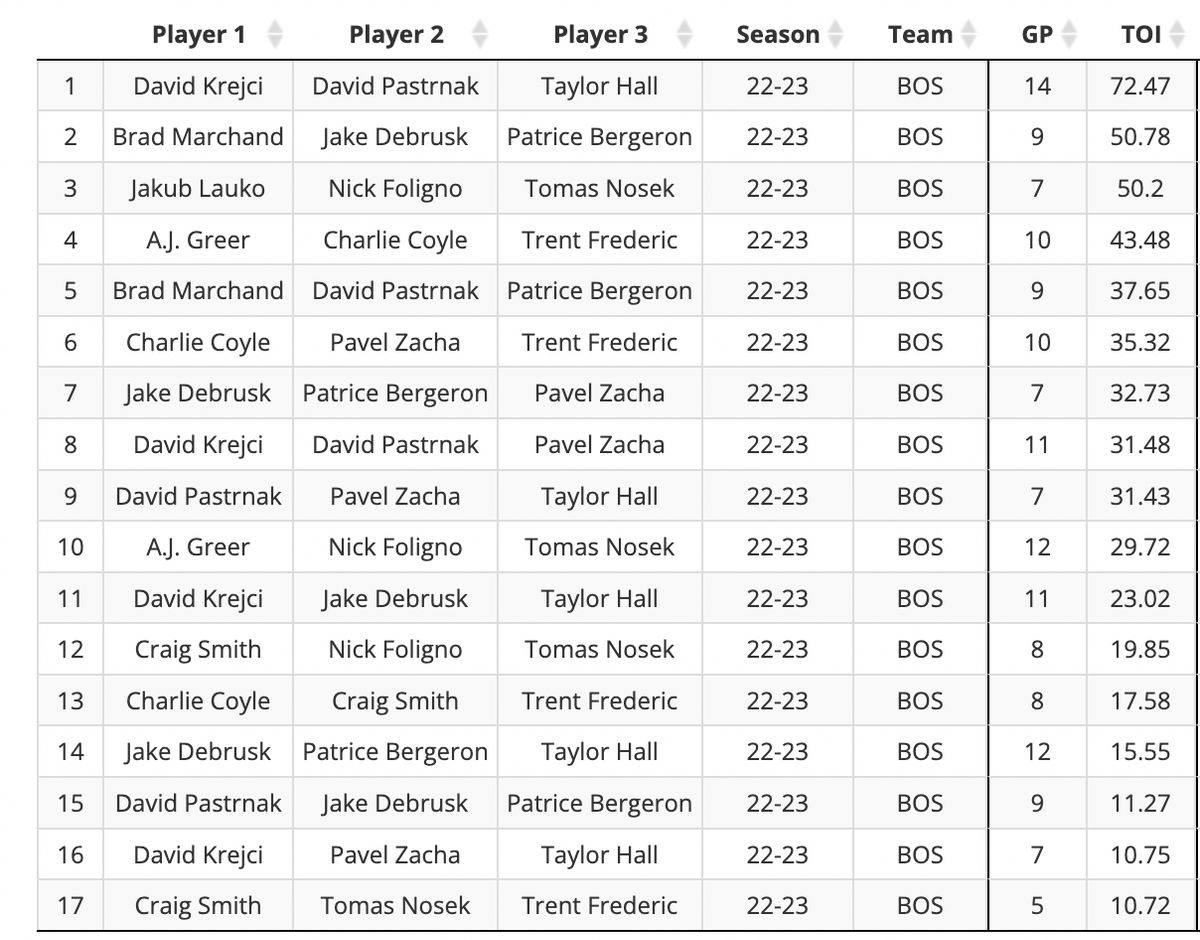
“I believe that players need to be able to play with everybody,” Montgomery said. “I kind of have certain players that have been — like Bergy and Marchy, I'm not going to separate them. But I think against certain teams, it's dependent on matchups, and sometimes it's just how players are playing and what I think is going to give the Bruins the most success."
While you could make the case that such frequent jumbling could stymie any chemistry forged between players, it’s tough to argue with the results put forth once players have shifted up and down the lineup — whether it be a Swiss Army Knife like Pavel Zacha or even a player like Taylor Hall, who scored a goal in Saturday’s win while skating with Charlie Coyle and Trent Frederic.
“Sometimes it's game to game, but it's more within the game,” Montgomery said of his mindset when it comes to switching lines. “Like sometimes it's the same thing with D pairings. Like McAvoy is really on top of his game and someone else isn't, I'll move McAvoy with a different partner. Same thing with the forwards. I do it more with the forwards. I like (assistant coach John Gruden) handle the D changes.
“But the forward group, I think we have so many moving parts and so many talented players that can play with each other, that some games, when it's an offensive-zone game, where we're going to have to grind out chances, I might look to put three players together that I think lend themselves and read off each other really well there. Whereas we're playing a team that maybe isn't as good at rush defense, I'll look to put a lot of speed on one line and three players that really make plays really well off the rush."
In the zone on defense
Ullmark’s fantastic showing between the pipes so far this season (12-1-0, .937 save percentage) has been a pleasant surprise for this club. One thing that hasn't been a surprise? The stingy, structured defense in front of Boston’s net.
For all of the tweaks that Montgomery has implemented for this team, he hasn’t done all that much with the zone defense that was installed by Claude Julien and refined under Cassidy.
Even though rolling out a man-to-man defense can be a bit easier to adopt and execute during in-game situations, Montgomery believes that an in-sync zone scheme stands as the most effective way to root out opposing scoring chances with regularity.
It’s tough to knock the results so far for Boston — with the B’s first in the NHL in goals against per game (2.06) and third in 5v5 expected goals against per 60 minutes (2.26).
"I think the zone is better, to be honest,” Montgomery said. “Just because I think the more reps you get, the more you understand it — like you can defend. You don't have to worry about what the other team is doing. You're doing your thing, which allows you to end plays more consistently. If you play Tampa, whose defensemen are really active, and you're a little more man-on-man, you spent a lot of time in your own end. If you're in this system, it doesn't matter what the other team is doing. It's how we're ending plays."
Plenty of rest prescribed
Considering Boston’s record out of the gate this season, it shouldn’t come as much of a surprise that Montgomery hasn’t subjected this roster to a few grueling bag skates over at Warrior.
On the contrary, the Bruins have actually spent quite a few days completely off the ice — with Montgomery prescribing plenty of rest for his team so far this year. Some of that can be chalked up to the age of some of Boston’s star players, with Patrice Bergeron and David Krejci already earning quite a few “maintenance days” on mornings when the rest of the roster is shaking off the rust.
But beyond just age or rewards for strong play on the ice, Montgomery believes necessary rest stands as a good way to keep any athlete fresh over the grind of a season that stretches on for more than half a year.
“It goes into a little bit about how the players — the soreness and injuries that we may have within the lineup. And then our Sports Science Department, I rely on heavily," Montgomery said. "And looking at how the players are doing, the output that they're doing, especially in practice, in relation to trying to get them to be their best for game time. I think our third periods show that we're in real good condition. Players are feeling really good with the way we've been able to play well in the third period. So I rely a lot on them. And then also with the communication with players and how they're feeling.”
And even on days where the Bruins do take to the ice (in sessions that usually only hover between 20-40 minutes), Montgomery tends to inject some levity into practices by way of some custom drills — including a full-squad scrimmage where every player needed to use an opposite-hand stick.
Monty was loving Opposite Day.#BehindTheB ➡️ https://t.co/bhzhURv7zG pic.twitter.com/uIDGvXAKtj
— Boston Bruins (@NHLBruins) November 16, 2022
"I really like him — he's got a really good way about him with respect to being able to be approachable and joking,” Foligno said of Montgomery. “And then also real serious in his meetings and the way he runs his practices. There's a time and a place to have a good time, but then when you have to work, it's time to work.”
Focused on the process
In a far-from-shocking revelation, Bruins players haven’t exactly been patting themselves on the back off of this 16-2 start, not with more than three-quarters of the 2022-23 campaign still yet to be played.
And while some of that thinking is a byproduct of a veteran leadership core that has been around the block once or twice — a lot of that sentiment can also be tied back to one of Montgomery’s mantras about adopting a process-oriented mindset.
"I think what's neat about our group and what Monty has brought in is just that we're so process-focused. And I think that allows us to flush a bad play out or a goal out and get ready for the next one — you get right back in,” Foligno said. “Whether he puts that line out and the little comments he makes, just get to the goal line — those little resets that we seem to have that kind of allows us to just get back on the offense or get back on the attack or get back to our game, really. And that's kind of what was said — there was a goal, it happens, and then boom, we can come back with a real heavy shift and that's what we need to have. And that's what good teams do.
“So it's a credit to the guys to understand the process that we're trying to build here and use to win games. That's why we're not so concerned about the results. The results take care of themselves. We feel like when our process is the way it is, and we've been dialed into that, we manage the game well. We've won our special teams, we've made a lot of contributions in different areas of the game and it's shown in our results.”
OTHER NOTES
Even though Derek Forbort (finger surgery) is still “weeks away” from a return, according to Montgomery, it does seem like the B’s are trying to resolve their looming cap crunch in short order by finding a new home for Mike Reilly — who is currently down with Providence.
“One thing just to watch out with them, I really think they’re trying to find a trade for Mike Reilly,” Sportsnet’s Elliotte Friedman said on his 32 Thoughts Podcast. “He’s back in Providence, and there was some question about whether or not he was actually gonna play there because they were trying to move him and the latest I heard was he’s probably gonna play there for the P-Bruins this weekend. I think they’re trying to find him a new home.”
As we’ve said before, a trade involving Reilly should be a win-win for all involved. Of course, the Bruins need to get cap compliant once Forbort is ready to return to the ice. And even if things haven’t worked out for Reilly and the B’s over the last year, the 29-year-old blueliner still shouldn’t be toiling around in the AHL ranks. He’s still a very solid NHLer who should be logging 18+ minutes a night on SOME team, especially one in need of some playmaking talent on the blue line.
---
Very disappointing to see that the NHL and NHLPA are not going ahead with a World Cup of Hockey tournament in 2024.
"Over the last year, the NHL and NHLPA have been working on plans to conduct the next World Cup of Hockey, the premier international best-on-best hockey tournament in February 2024," the NHL and NHLPA said in a statement. "Unfortunately, in the current environment, it is not feasible to hold the World Cup of Hockey at that time. We continue to plan for the next World Cup of Hockey, hopefully in February 2025."
Whether it be the logistics related to fitting the tournament into an already busy NHL calendar or the potential optics of letting Russia participate amid the ongoing war in Ukraine, the NHL and the NHLPA are opting to kick this can down the road a bit.
Here’s hoping that a legitimate tournament is mapped out in the near future. Because after the latest Olympic participation was scrapped for NHLers, it’s still a shame that hockey fans have not been treated to some international competition featuring the likes of Connor McDavid, Auston Matthews and plenty of other young superstars who would be proud to represent their respective countries.