
Quick question, and don't study these pictures that closely.
At quick glance, is this the same play from the Patriots' Sunday win over the Browns? Or two different plays?
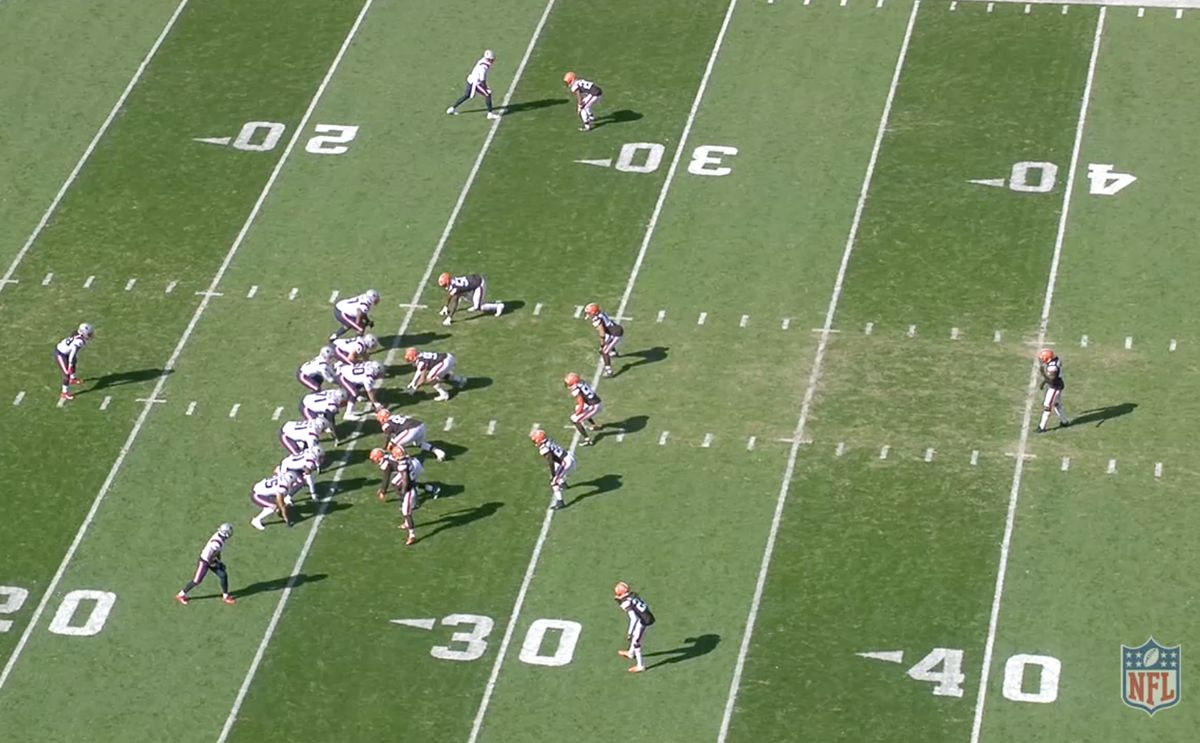
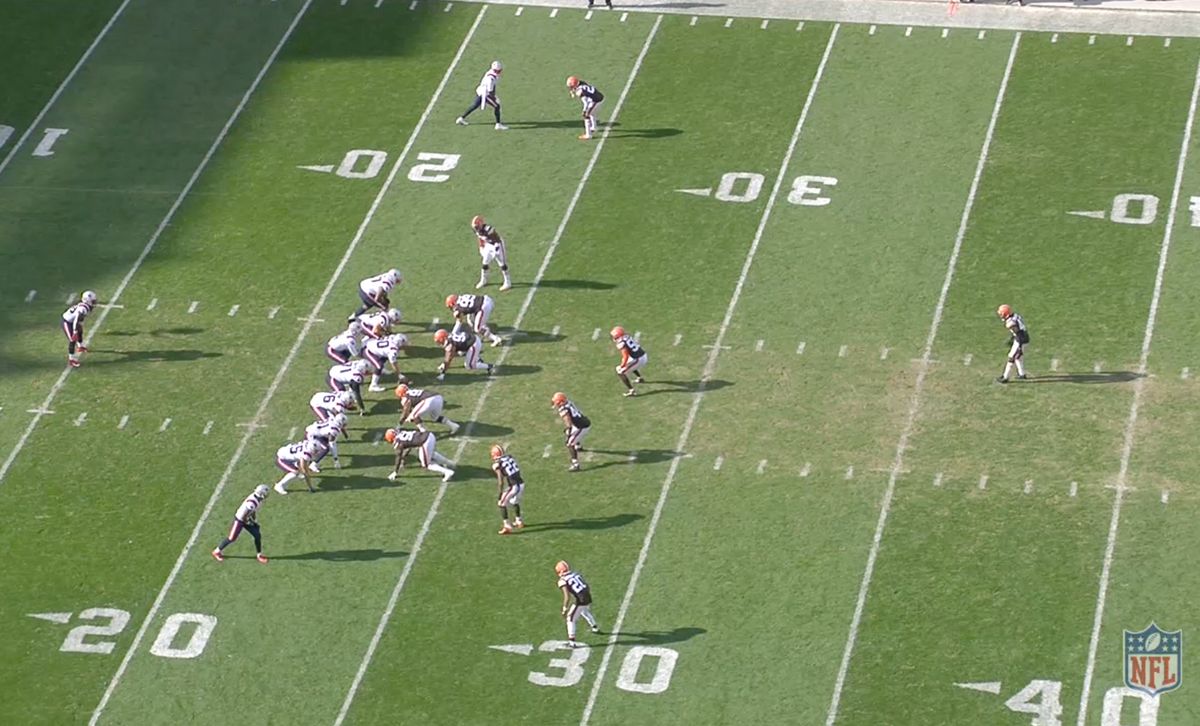
Obviously, the more you study it, the more you can tell these are two different plays — from the second and fourth quarters. Amazing that it's almost from the same yard line on the same side of the field, and the same down — 1st and 10.
Both had similar results to the same player: Jakobi Meyers.
1-10-NE 25 (7:11) B.Zappe pass deep left to J.Meyers to NE 45 for 20 yards (M.Emerson).
1-10-NE 23 (14:30) B.Zappe pass deep right to J.Meyers pushed ob at 50 for 27 yards (G.Newsome)
I was hoping to use these plays as an example of GREAT playcalling and coordination by Matt Patricia to illustrate his growth game by game. To do that, I would have needed to see this same formation with a run previously in this game, which would have set up this play. That's high-level NFL coordination and would be a great sign for later in the season against better defenses and teams.
But this is the first time they ran a play, in this game, out of this formation (perhaps they did it in a previous game, which would be a bonus point). So this first play is a good playcall by Patricia, and hopefully another step towards really growing into this role.
That Patricia came back to this play two quarters later, and that Meyers ran a different stem at the top of the route (first one went inside, the second outside), is a job well done by all. I have no clue who to give credit to, because on NFL sideline a little tip could come from anywhere — the playcaller, QB coach Joe Judge, Meyers or even Mac Jones armed with a tablet. But it was certainly a pleasant development to see the Patriots set up a play, and then run a different version of said play. It at least shows that they are thinking of offense on a higher level and that bodes well for later in the season.
Both plays — with the same personnel, formation and run action — had different aims, that's for sure.
The first play, which is a basic over (DeVante Parker) and under (Meyers) route concept, Bailey Zappe clearly wants to go to Parker, but he's reading the free safety. This play puts that player in a bind — either he plays the over or under route — and you read his reaction. Zappe sees the free safety help on Parker, so the QB is automatically Meyers. You'd like Zappe to throw this ball with more anticipation and velocity to give Meyers a YAC opportunity — despite an max protection and incredible pocket, Zappe shows his arm limitation by throwing a ball Meyers has to stop, jump and catch in some traffic — but it certainly got the job done.
On the second play, it's clear that someone has suggested going back to the same play but having Meyers fake inside and go outside. Again, that could be anyone, even Bill Belichick. Meyers could have lobbied for it. It could have been Patricia.
Zappe definitely was given marching orders to sell, even harder, a pass Parker to hold the safety and give Meyers more room to operate. Zappe looks left at the start, but quickly comes back and throws the ball to Meyers. Again, you'd like to see more velocity on this pass — you could use this an example of the line between NFL backup and good starter — as the ball dies a bit at the end, but it's certainly good enough.
Both plays are great examples of Meyers' elite route running. He may not be fast, but this is how does a great job creating separation.
The bottom line: the first play was a good job on film study anticipating what coverage you're going to get, and having the right play call. The second was a great adjustment by all to get even more yards.
These two passes accounted for 5 percent of Zappe's dropbacks in this game, but accounted for 15 percent of his yards. That's pretty efficient.
31 3 3-1-CLV 31 (5:39) M.Cannon reported in as eligible. B.Zappe pass short left to H.Henry for 31 yards, TOUCHDOWN.
Similiarly, I was hoping to use the Hunter Henry play as another example of advanced playcalling. I searched for similar formations and motion by Henry on a running play, but it was not to be found — perhaps Patricia is building to that.
Instead, we'll have to settle for this being a really good playcall given the situation (3rd and short). Good to see the aggression here. Do I think the Patriots were a bit emboldened by the score (17-6), field position (Cleveland 31) and the fact that they were already in field-goal range? Yes. But its still a good call and obviously Grant Delpit was fooled by the run action.
Most of the credit, in my opinion, goes to Henry for his subtle run-blocking fake – that makes Delpit have to prepare his body to be blocked by a bigger player — and arm-over move that leaves Delpit so fooled he has to try and fails to take Henry, leading to the wide-open touchdown: