
For a hot second, it looked like Jayson Tatum was in for a hot shooting night in Game 4 of the NBA Finals. He’d hit his first three 3-pointers on his way to a 12-point first quarter on 4-6 shooting. Yeah, he missed a free throw and a couple of layups, but this was shaping up to be a 40-piece for Tatum, and a potential signature game for him.
It all fell by the wayside, though, as he shot 4-17 the rest of the way, 1-5 on 3-pointers. He was 4-15 inside the arc, notably struggling on his layups and shots around the rim again.
“At times he's looking for fouls. … That's the ongoing theme so to speak, him getting to the basket, being a scorer as well as a playmaker,” Ime Udoka said. “They do a good job with their rotations. Sometimes hunting fouls instead of going to finish. I've seen that in a few games so far.”
When Tatum is at his best, he’s an elite finisher at the rim. In March, he shot 76.5% in the restricted area. In April, that jumped to 81%.
It’s 56.5% in the playoffs.
Tatum’s attacking is a centerpiece of Boston's ability to score in the halfcourt. He and Jaylen Brown are two gifted attackers who can put a lot of pressure on defenses. Tatum, though, tends to revert to some bad habits when he drives, and it hurts his chances of both scoring and getting to the line.
At his worst, Tatum drives past the rim and tries to score from the side of the basket. In these instances, he glides and tries to avoid the contact.
The issue here is that he doesn’t avoid the contact at all, but because it comes from behind as Gary Payton II gets him with the body, it does nothing to change his momentum in any way.
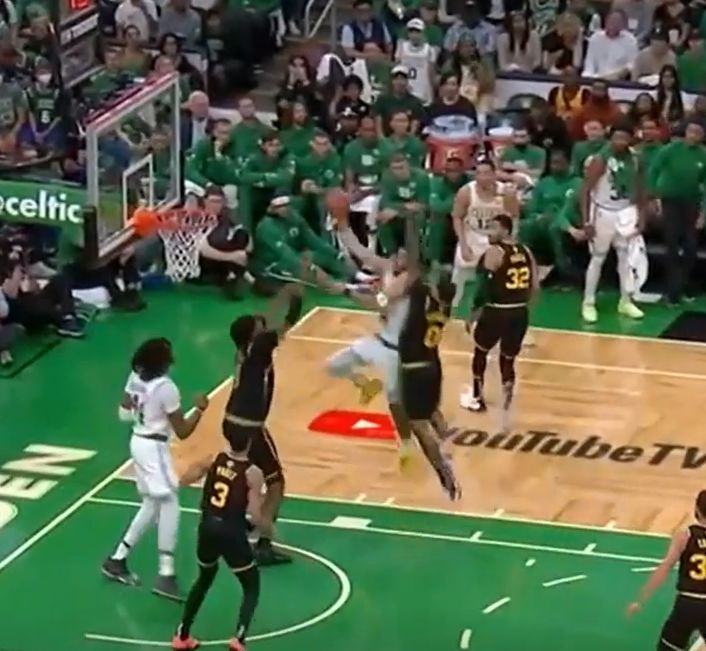
Tatum is going to his right, gliding through the air, and the extra bump from Payton’s body doesn’t appear to impact Tatum in any way. Officials, especially in the Finals, are looking for contact that changes a player’s trajectory; that somehow clearly disadvantages the player and prevents him from finishing the play.
That doesn’t outwardly appear to be the case. Tatum’s momentum is still going where it’s going. Nothing seems to change. But because he’s getting bumped, even slightly, in mid-air, the calculus between Tatum’s body and mind that determines how to finish is thrown off.
Every time a player jumps, shoots, passes, or does anything requiring timing and coordination, his brain and body are making rapid-fire calculations about how high to jump, or how much arc to put on a shot, or how much speed or spin to put on the ball.
When a player gets bumped like this, it’s like changing one of the numbers in Tatum’s equation. It throws the whole thing off. If Tatum can’t properly adjust in mid-air, there is a greater chance the shot will miss, even though it doesn’t look like the contact has done anything to impact Tatum.
Here’s another example.
This time Tatum glides to his left. Andrew Wiggins puts an arm on Tatum’s waist and has the same effect on the layup attempt.
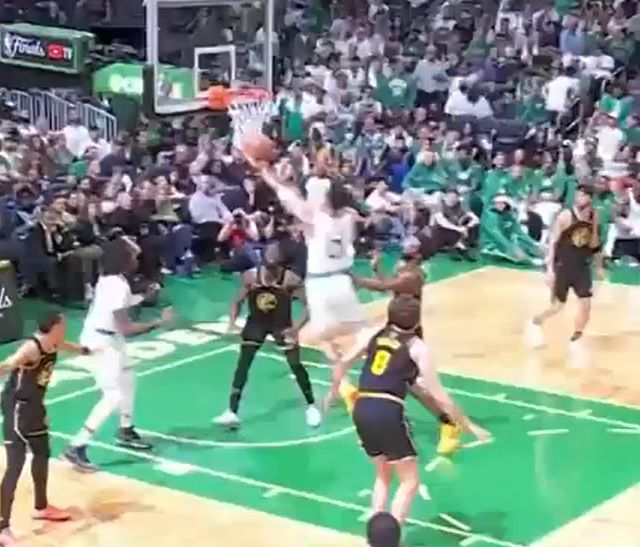
This could be called a foul, but again, the refs are looking for things that obviously throw a player off. Tatum’s gliding essentially gives the defense a smoke screen. They can nudge him in the direction he’s jumping and impact his shot without actually looking like they're fouling.
Tatum has talked about having to play off two feet more often in the past, and that has to be a focus again over these last two or three games.
Playing off two feet gives a player power and control when going up. For example, against Wiggins, Tatum has an opportunity when driving left to get into the lane in a more straight line and off two feet.
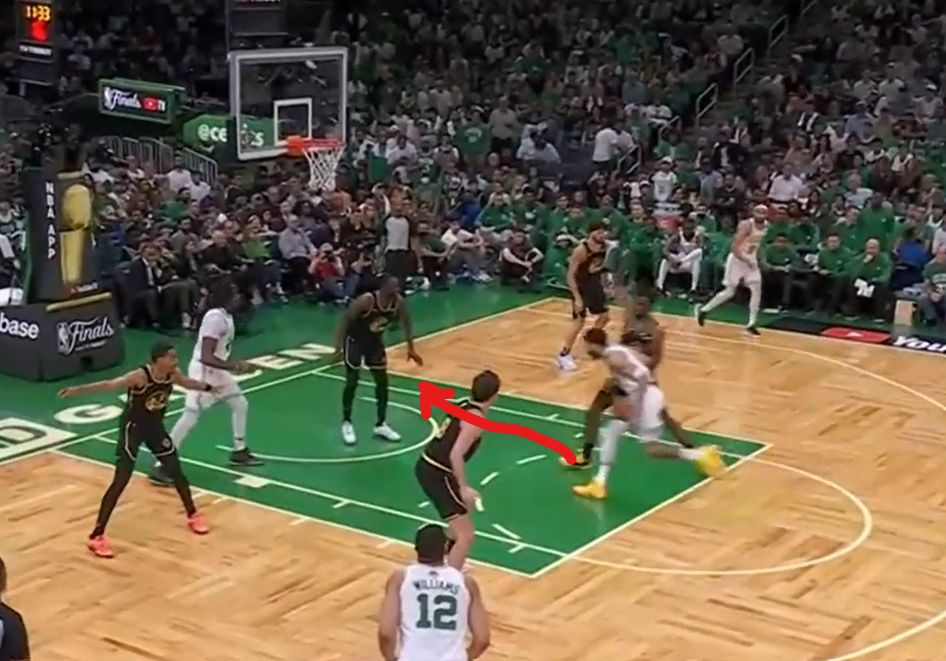
This is on Tatum to do a couple of things on the drive. First, initiate the contact with Wiggins with a little direction change to his right and a shoulder into Wiggins' chest. That creates an opening to establish a path down the middle of the lane rather than continuing his dribble to his left so he can glide past everyone.
Once he creates that opening, a simple pro hop sets his feet and power so he can go up on Draymond Green. There's a good chance Wiggins will still be chasing from behind, but this time if he hits Tatum, he’ll knock Tatum off his axis, creating an obvious change in direction and momentum that shows he’s been disadvantaged. That's where Tatum will draw the fouls.
The power behind the jump also allows Tatum a chance to adjust to Green’s challenge in mid-air. It just makes it much more likely that he can finish the play and draw more and-ones.
He can also use the two feet to stop his momentum and essentially flow into a post move.
This is an easy way to get some points in the restricted area in a five-out situation when you know there's no help or rim protection. It’s also a wonderful way to keep the defense guessing. Throw two or three of these at a team and suddenly the challenges on those one-foot gliding layups are a little late because they're not sure what you’re planning to do.
Different looks keep opponents off-balance. If nothing else, Tatum should spend some of his flight time between San Francisco and Boston to watch some Hakeem Olajuwon game film and incorporate that into his game every once in a while.
This all requires a different level of aggression from Tatum. He needs to play with a little more ferocity attacking the rim. The gliding is fine from time to time, but he has to be more forceful on his attacks, create some space by initiating some of the contact, and then finishing through defenders after doing so.
Steph Curry scored 43 points last night, but if Boston had just cleaned up some of the turnovers and missed opportunities like these at the rim, the Celtics could still be up 3-1 right now.
“I know I'm impacting the game in other ways, but I got to be more efficient, shoot the ball better, finish at the rim better,” Tatum said. “I take accountability for that. I just look forward to Monday. Leave this one behind us. Learn from it, watch the film, things like that, but everybody probably feels like they got to be better, myself included. Just go get it on Monday.”