
Bruce Cassidy liked the club he had in place just ahead of the 2022 Stanley Cup Playoffs.
While perhaps not as confident as Brad Marchand — who remarked in the aftermath of Saturday’s Game 7 loss to Carolina that Boston could have cleared a path to the Stanley Cup Final had it bested the Canes — Cassidy had good reason to believe in a group that appeared primed for a deep Cup run.
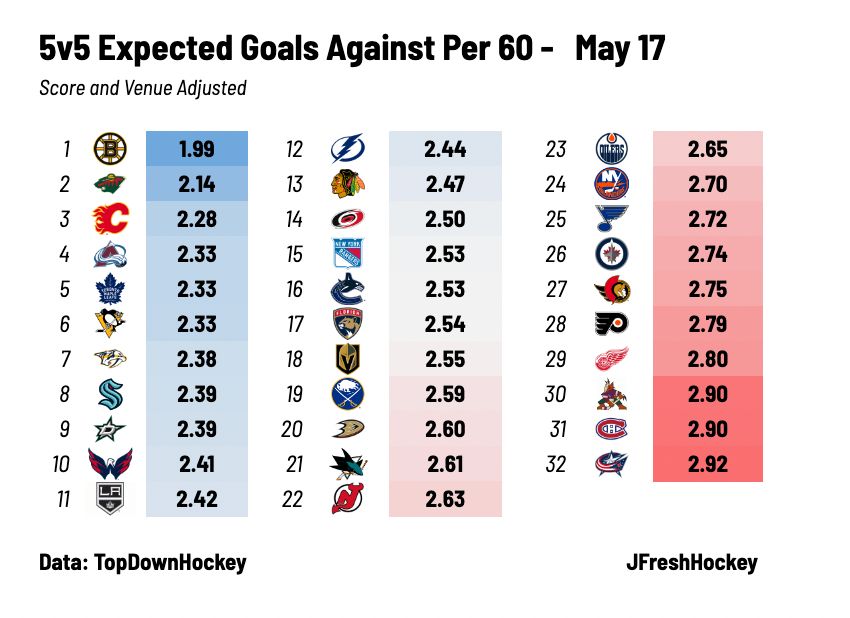
The foundation of Boston’s success was entrenched in its stingy defensive structure, with the B's ranking fourth in the league in goals against per game (2.66) and first overall in 5v5 expected goals against per 60 minutes of play (1.99).
While the state of Boston’s goaltending was a bit of a wild card going into the year, a tandem of Linus Ullmark and Jeremy Swayman offered promising returns, with Ullmark hitting his stride down the final stretch of the regular season.
And even though the B’s offensive capabilities were once again anchored by their star talents like Patrice Bergeron, David Pastrnak and Brad Marchand, Boston’s second-half surge offered hope that more secondary scoring was going to be a given ahead of the postseason — be it Jake DeBrusk’s positive returns on the top line, Erik Haula looking like a capable 2C in March and April and the third line of Charlie Coyle, Craig Smith and Trent Frederic poised to become bottom-six mismatch over a seven-game series.
And yet, once the dust settled at the end of that seven-game slugfest against the Canes, the Bruins once again found themselves hampered by the same ol’ flaws that detailed other promising playoff campaigns in the past five years — a dearth of tangible production outside of that top line.
Perhaps you could chalk up some of Boston’s scoring woes to the fact that the Bruins were consistently frustrated by a Hurricanes team that ranked first in the league in goals against per game.
Cassidy made sure to give Carolina its due during his end-of-season presser on Monday morning. But, as has been the case throughout these last few failed Cup runs, plenty of Boston’s offensive woes were once again a byproduct of a talented roster failing to finish the chances it managed to generate.
“I thought we had turned the corner in the second half with some of that,” Cassidy said of Boston’s goal of playing a more cycle-heavy game in the offensive zone. “And the test always comes in the playoffs. We just happened to run up against a team that was rock solid defensively. So were we that far off from it? Is it all on us? Or do we give the appropriate amount of credit to the team that we lost to that was a very good hockey team and knows how to shut teams down? I think it's a little bit of both.”
Of course, while Carolina does deserve some props, the fact of the matter is that any subsequent playoff push for this B’s roster (so long as Patrice Bergeron is still part of the equation) is going to require Boston to get the better of other stingy, defensive-minded clubs.
In order to do that, the Bruins need to once again fixate their focus this offseason on trying to draw more consistent offense out of this group. It’s a task easier said than done, given Boston’s failed endeavors over these last few seasons.
As we noted on Sunday morning, one potential avenue that the Bruins might take in order to coax more scoring out of this group is augmenting Cassidy’s team structure — perhaps sacrificing some of that stout defensive identity and encouraging creativity and risk-taking down the other end of the ice.
"We're always going to look at trying to get better," Cassidy said. "That's the generic statement. For us in particular, yeah, we need to find ways to generate more offense. Is the personnel in place to do that, and we're just playing the wrong way? Do we sacrifice defense — what we're very good at — to generate some offense? I mean, we have to consider that. I mean, that's definitely a possibility.”
The Bruins certainly had no qualms when it came to putting pucks on net this season, with Boston ranked second in the league in shots on goal per 60 minutes of 5v5 play (36.4). In terms of outright shooting percentage, Boston ranked 30th overall at 8.5 percent.

The issue, of course, is that the heavy quantity of shots didn’t always amount to quality looks — with the average expected goal value of Boston’s 5v5 shot attempts ranked 31st in the league (ahead of only the lowly Kraken).
Some of that could be chalked up to Boston’s frustrating knack for missing the net outright with their chances, but Cassidy did acknowledge that perhaps the B’s could shift their thinking a bit — opting to hold onto the puck in the offensive zone and try to swing for the fences with a Grade-A chance, as opposed to putting pucks on net and working to get the biscuit back.
The risk you run with that shift usually lies in passing up good looks for slam-dunk chances, which are often hard to come by in the fracas of a competitive hockey game.
“We led the league, I think, on shots on goal — so we're playing off the shot a little more than most,” Cassidy said. “So shooting percentage gets skewed because of that. We're playing for a rebound so we can recover the puck first. I know Bergeron does that as well as anybody. Coyle's line, when they're going. We're not one of those teams that's looking for — I think the Rangers are more of that. 'Okay. They're looking for that play that's a high percentage'. That's certainly open to discussion, should we be more of that team?
“Hang on to the puck, look for that really good chance instead of sort of playing and putting pressure on a team over and over and get some second and third chances? So that's a little bit of philosophy that we'd have to discuss for the shooting percentage. To me, it's more about are we generating enough good opportunities — how many high-danger chances, all those metrics we talked about earlier. Expected goals? They do matter in some regards of what are you generating over a long picture.
“And we didn't do well enough with that against Carolina. Like I said, some of that's a credit to them, top defensive team, some of that was on us to be able to break down some of their man-to-man coverage a little bit better. So I would say that is more important in our evaluation going forward than necessarily a shooting percentage number. Because I think it can be skewed.”
After watching them over a seven-game series, the Hurricanes sure seem to have a pretty effective blueprint when it comes to cultivating that offense, with an active and shot-ready D corps adept at finding lanes and feeding pucks into danger areas for high-danger tips and rebounds.
Perhaps a full season of Hampus Lindholm could help encourage more of that from Boston’s D corps when it comes to peppering the net from the offensive blue line. But the onus will have to fall on more than just one blueliner to generate those looks.
Boston could look to the future and hope that a youngster like Fabian Lysell could make a push out of camp (a pretty unrealistic ask, in my book), or perhaps look for other internal candidates like Craig Smith to bounce back after a season in which his shooting percentage also dipped a bit (8.6 percent in 2021-22, 9.8 percent in 2020-21.)
After failing to produce results against Carolina, it’s not out of the realm of possibility for Boston to also look outside of the organization for more scoring help.
But, with Boston’s offseason outlook currently murky given Bergeron’s status — coupled with a lack of available cap room — Boston’s efforts to add impact talent to this roster, much like its mission of generating more offense, is easier said than done.
“There are some players that can give us more," Cassidy said. "There always is. I thought we got a lot out of this group, especially the second half, got them in place and the offensive numbers showed that. So we got to figure out, 'Okay, how do we get them to do that in the playoffs as well?' So that's a challenge for the staff as well as the player himself to know that the game shrinks a little bit, the ice available. … And then we'll talk about upstairs with personnel. Are there better options? Of course we'll have to look at that. … I think you're always looking to improve. Who are the guys? Is it internal or external? I think those are questions we have to have discussions about.”