
When Alfie Michaud first caught wind of Jeremy Swayman’s unorthodox choice of an elective class during the 2019-20 collegiate season, it didn’t register as much of a surprise.
For as much as Swayman’s athleticism, poise and cheerful disposition have long been hallmarks of his persona, Michaud was quick to catalog another redeeming trait rooted within the promising netminder.
The propensity to embrace change and keep an open mind.
During Swayman’s tenure at the University of Maine, Michaud — the Black Bears’ assistant coach and a lauded goalie in his own right — relished every opportunity to work with his talented understudy on their shared craft, with the student seeking every possible avenue (conventional or not) to improve his game.
“That's a strength of his. He's always keeping an open mind,” Michaud said of Swayman. “He's listening to everybody and we talk about it. It's like a buffet, right? You go to a buffet and everybody has different choices when they get to the buffet, but it's okay to try something. You're not always going to like what you try. I think that's what good goalies do. They try things and sometimes it works for them.”
So when Swayman opted to sign up for a ballet class during his junior season — Michaud could see the method behind the perceived madness of melding edge work with entrechat.
For Michaud, any off-ice work is good work, especially for a young athlete looking to unlock new ways to strengthen their body.
Of course, Swayman’s rationale for taking said elective didn’t register on quite the same wavelength — although it certainly resonates with countless other upperclassmen in college.
“Two seniors took it in the first semester, and they were all joking about it. Like, ‘Yeah, it's super easy,’”, Swayman told BostonSportsJournal.com of his ballet course. “I was already done with most of my core business classes. So I was looking for electives. And one of the electives was ballet. So I just had an open mind about it. And I convinced two other guys to do it with me.”
At the time, Swayman wasn’t putting all that much stock in a class designed more as a light-hearted release from the pressure-cooker environment that comes with being the No. 1 option between the pipes up in Maine.
That is, until both he and Michaud started seeing the results out on the ice.
For as much as Swayman’s first two years with the Black Bears showcased plenty of the Anchorage native’s promise, it wasn’t until that 2019-20 campaign that the Bruins prospect’s stock really soared — setting him on an upward trajectory that carried him from Alfond Arena to TD Garden in the span of just 13 months.
And while one elective class can’t take sole credit for Swayman’s progression with something as technical as netminding, the lessons learned from his scheduled sojourn to the ballet studio remain ingrained in Swayman’s off-ice training and overall preparation.
“I didn't go into it thinking, 'Oh, I'm going to get better ankle stability or flexibility,' but that's exactly what happened,” Swayman said. “We did it twice a week — and we had homework with it too where we were all dancing.
"But it was the movements themselves and just the coordination you had to have and body awareness that all went into it. And I think it completely mirrored my game and helped a lot.”
The numbers spoke for themselves as Swayman’s junior season progressed.
Maine put forth a resurgent 18-11-5 record that season, with the play of Swayman in net holding plenty of … sway over said results. Even though the Black Bears surrendered 34.6 shots against per game — 56th out of the 60 D-1 teams — Swayman stood tall against those multiple salvos, leading all Hockey East goalies with an absurd .939 save percentage and a 2.07 goals-against average.
And even though the COVID-19 pandemic halted Maine’s chances of making some noise in the postseason, Swayman still came away with plenty of hardware, winning the Mike Richter Award — given annually to the nation's top collegiate goaltender — and the title of Hockey East Player of the Year.
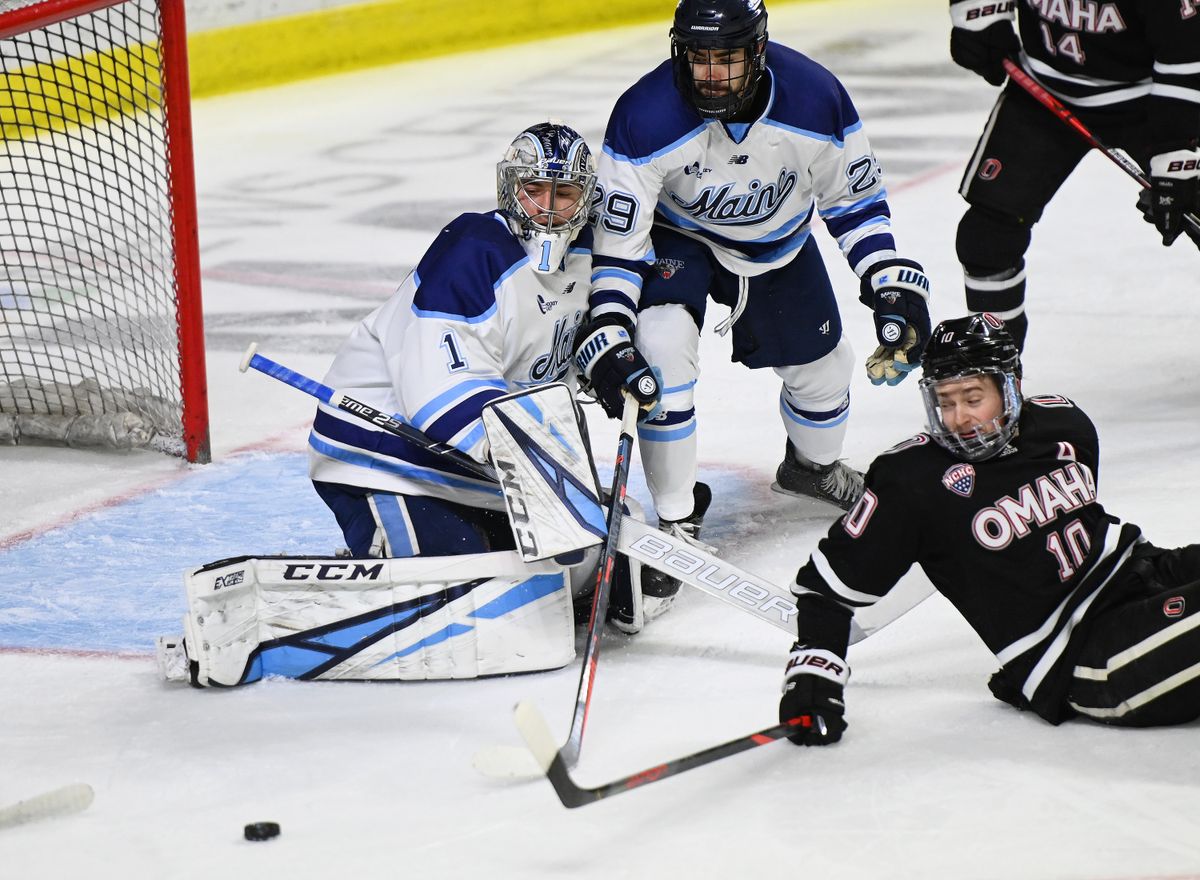
(Staff Photo by Shawn Patrick Ouellette/Portland Press Herald via Getty Images)
For Michaud — who helped lead Maine to an NCAA title in 1999 before embarking on his own pro career — Swayman’s strides were aided by the young netminder gaining a better understanding of his physical profile and how to best utilize it when pucks start flying and lateral acceleration is needed to stave off Grade-A looks.
Some of that understanding likely wouldn’t have been achieved, in Michaud’s view, without the work Swayman put in during those ballet sessions — which place repeated emphasis on strong footing, posture and ankle mobility.
“I think it’s just body awareness,” Michaud said of Swayman’s improvement post-ballet. “I got a young daughter that's heavy into dance and I think that’s the biggest thing. He started to understand when his extremities got away from his body and what that does to your speed and everything. He just became a lot more aware of his body and when he sank down into a stance, he could feel it. He was already explosive and flexible, but I think he just took it to another level.
Compared to some of his other Bruins teammates now, Swayman’s job description might seem a bit more … sedentary.
He’s not tasked with walking the offensive blue line like Charlie McAvoy, nor is he asked to duck and weave past forecheckers like Matt Grzelcyk on a breakout bid.
You won’t see him gliding through the neutral zone like Taylor Hall, nor will he be dicing up an opposing defensive structure via an array of dekes and dangles as Brad Marchand is prone to do.
But just because the parameters of Swayman’s gig limit his skating ventures to the crease and the small amount of real estate within the trapezoid, that doesn't mean that he's just a bystander when his teammates are putting in work off the ice. Sure enough, the days in which the conditioning gap between skaters and netminders stretched as long as a daytime drive between Boston and Orono are now a thing of the past.
As hockey has moved further away from size and snarl and embraced speed and skill, goaltenders have had to evolve their games to keep up with these uber-talented next waves of players.
And even though their playing careers are separated by close to two decades, both Swayman and Michaud have witnessed firsthand that evolution of off-ice training for goaltending.
“I remember my first (NHL) training camp was in ‘99. I think the guy doing the (conditioning) test grabs you, pulls you to the side and is like 'Ah, you're a goalie. You're good.' It was that kind of deal. Now, it's expected for goalies — they got to be just as athletic and just as in shape as the forwards and D,” Michaud said. “Really, when you think about it, the equipment has changed obviously, but they're still skating around with 20 pounds of gear. I think you got to be able to maneuver and be athletic and agile. So the training has definitely got to another level.”
Jeremy Swayman denies Garnet Hathaway on the breakaway. pic.twitter.com/qjz9a1Fsvd
— Conor Ryan (@ConorRyan_93) April 8, 2021
For as much as Tim Thomas’ ringing endorsement of yoga generated plenty of headlines during his days manning Boston’s net, embracing such an off-ice routine is now commonplace for many netminders looking to improve flexibility and strengthen their core.
And while the pool of goalies that incorporate barre and other ballet-influenced exercises into their routine isn’t perhaps as deep at this juncture — Swayman believes that it will continue to catch on as more athletes look for other outlets to work on their game.
“I think I'm actually in the perfect age group for that transition from the old school to the new school of trying the barre, trying the yoga,” Swayman said. “I thought that has been super beneficial for me. I've done yoga for over five, six years now. … So I think it's all really beneficial.
“Anything with stability, especially for goalies — core stability, leg stability, hip mobility, all that stuff. It all goes into account when you're playing in these sporadic positions. So I think I'm in a great position and an age group to kind of take over and make that a norm.”
Just before Swayman turned pro, Michaud shared one phrase with his mentee as he embarked on his (soon-to-be-accelerated) path toward the NHL.
“Just be where your feet are at.”
For Swayman, it’s a venture that’s often easier said than done, considering just how much he’s skipped around between Alaska, Sioux Falls, Maine, Providence and now down in Boston.
Your daily Jeremy Swayman update: pic.twitter.com/iGZxeBRE3m
— Conor Ryan (@ConorRyan_93) May 14, 2021
And even though Swayman's feet are planted exactly where he wants to be — he's far from satisfied with just making it up to the NHL ranks.
To fully realize his potential, Swayman knows that he'll need to take another step forward at some point. The manner in which he does that is anyone's guess.
But, as history shows with Swayman's prior course work, sometimes the most effective spark for progress is just taking a leap of faith.
Or chassé, in Swayman's case.
"I think as soon as you think you know everything, you better quit hockey,” Swayman said. “You're always learning and the biggest thing for me and many other goalies is that you're never going to make the same save twice. You never let in the same goal again.
"So it's that kind of thing that you're always learning. And you have to keep an open mind because that's the way hockey is. That's the way life is and that's the best way to take it. “