
A lot has been made about Boston’s win over the Sixers because they ended up winning easily without taking or making a ton of 3-pointers. For some, it represents a departure from “Mazzulla ball,” because people believe that Joe Mazzulla is enamored with 3-point shots and always prefers those over everything else.
“I don’t love 3s, I love great shots,” is the headline from his postgame press conference. He expanded on that a little when he said “we’ve never said we have to win doing this, that’s never been stated. We always take what the defense gives us, we’re one of the best teams at doing that, and that’s kind of our offensive philosophy is take the best shot and find the best shot.”
There are a few things that played into getting to this point with Mazzulla and his offense. Obviously, first and foremost is the fact that the Celtics take more 3-pointers than anyone else in the league. Secondly, they have a bunch of guys who can shoot it pretty well, so they're not afraid of taking them. And finally, the first season under Mazzulla featured a few non-shooters on the floor, leading to defenses that could pack the paint and help off of guys without fear of being burned. That meant 3-pointers were often the best shot available, so they went up with impunity.
The reality of Mazzulla’s offense is that while the result is very often 3-pointers, it’s because most of them are open. As I mentioned after the Sixers game, 36 of Boston’s 42 3-pointers per game are either open or wide open, so they generate a lot of good looks. The math on the 3-pointers dictates that taking those open shots will lead to a lot of points, something we’ve seen bear out over the course of the season.
Still, 3-pointers and current NBA strategy is still somewhat divisive. There are plenty of people who prefer in inside-out approach of attacking the basket for layups first and then shooting off those. However, that approach has its flaws as well, most notably the very rigid demand that only certain shots be taken at certain times of the game. It adds a layer of predictability where a defense can say “Boston will only attempt layups in the first quarter, so we’re going to leave all shooters and pack the paint.”
The Celtics have been programmed to take what the defense gives them, which simply means read what the defense is trying to take away and attack the other thing they're leaving somewhat open. Because the Celtics are adept at both shooting and driving, they can easily morph into whatever is necessary.
Which brings us to the Sixers game, which was an outlier of a performance for a very specific reason: The Sixers were absolutely awful on defense. Any notion that Boston played differently because of how the box score ended up is wrong. The Celtics ran the same offense, the same way, but just met no resistance at the rim.
The hierarchy is still layups/dunks, then free throws, then 3-pointers. Defenses are generally designed to take away the rim, run out to shooters on the perimeter, and hope the mid-range shots aren’t falling at a high enough rate to be killers. Boston’s offense is designed to attack that rim protection, collapse the defense, and then find the openings and advantages off that.
Very often, it results in drive-and-kicks. That will often build into drive-kick-swing for open 3-pointers, which leads to Boston’s very high number of above-the-break 3-pointers. From there, there are variations of drive-and-dump off to a guy along the baseline or a cutter. Or drive-kick-drive, drive-kick-swing-drive (add an extra kick there for a corner 3).
You get the picture.
It’s usually drive-(something) for Boston. It’s just that the drives against the Sixers didn’t have anything following them.
The Celtics average 39 drives per game this season. They drove 41 times against the Sixers, so there was no real extra emphasis on it. Two more drives in a game is just normal variance. The difference is that Boston took 21 shots and made 62% of them against the Sixers while they normally shoot 18 times at 54%. Boston drives normally account for 63.5% of Boston’s points, but they netted Boston 80.5% of them against the Sixers.
It’s not that they drove more or placed more emphasis on it. They just took a few more shots off the drives and made a ton of them.
It’s funny how results can mask what the process really looks like.
Here are a few examples from the game to show how similar plays have generally resulted in passes, but became layups against the Sixers.
High pick-and-roll between Jrue Holiday and Kristaps Porzingis is a common play, but this one gave Holiday a clear path to the rim because Paul Reed froze. That was clearly a miscommunication where the defense didn’t know what they were supposed to be doing, and the result was a layup line deuce.
Normally, Holiday would find some resistance on a pick-and-pop like this. Porzingis being wide open at the top of the key like he was is usually a recipe for a 3-point shot.
Usually, Holiday is looking for passes out of his drives. He’s very willing to sort of announce to everyone “hey look at me, I’m driving! Come get me!” like he’s Kevin McCallister baiting the Wet Bandits into getting a paint can to the face.
This is much more like Celtics basketball. The drive draws the defense, the kick draws the overreaction, and the swing is the hammer. But it all starts with someone getting in Holiday’s way, which didn’t happen against the Sixers.
It didn’t happen on this play, either.
Just look at how wide open this lane is.
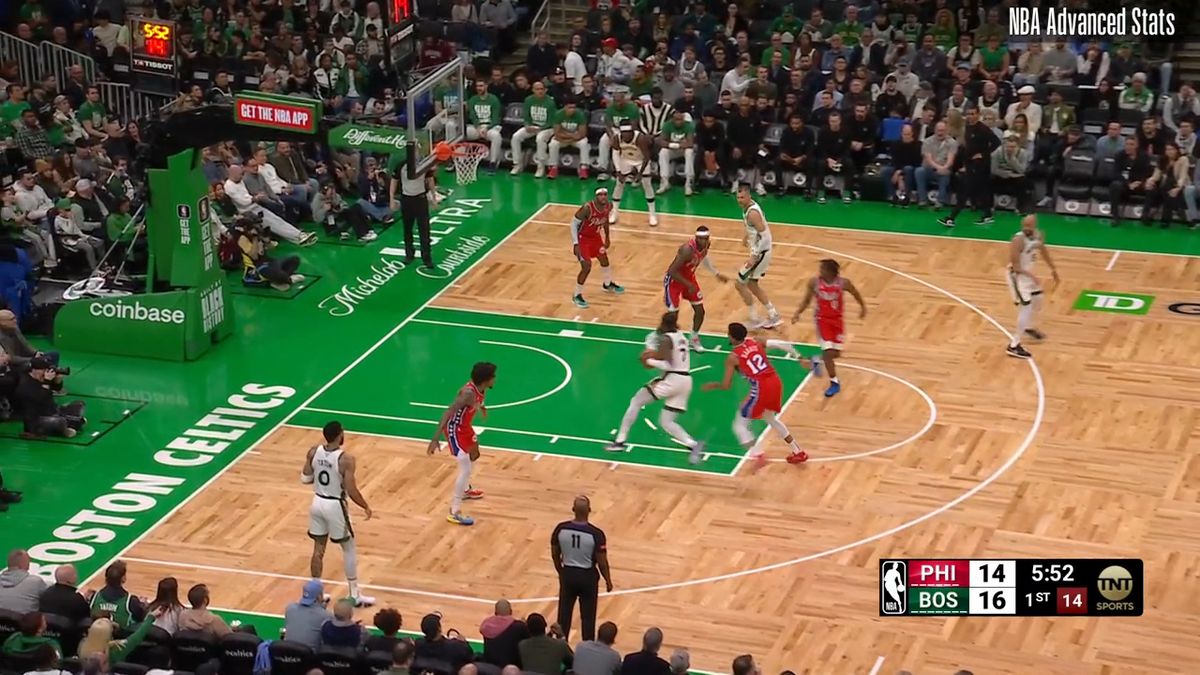
Usually, that little lefty drive is a hook pass from Jaylen Brown to Porzingis for a 3-pointer.
And sometimes the defense steps up to prevent the drive altogether, which Porzingis reads as a roll opportunity, which subsequently opens up a 3-point shot for someone else.
The Celtics even got a rare corner drive and layup from Al Horford
That's not typically what Horford is looking to do when he puts the ball on the floor. Horford is more of a spot-up guy, but he’ll attack when a defender is being overly aggressive.
But Horford doesn’t really like to put the ball down in the half court. There are a lot of hands in the way, and it can get dicey for him, so he typically prefers to dribble until he draws the help and then makes the right pass off that.
This is more like the Horford we know and love. The dribbles draw defenders and Horford expertly picks off the advantage.
These are just a few examples of plays that typically end up as 3-pointers but were finishes for Boston on Tuesday night. The moral of the story is that Boston didn’t really play much differently than usual. They just got different shots because the defense was allowing something completely different. They made the right reads (which is pretty easy when the read is "oh look there's no one between me and the rim") and took the right shots.
So when the Celtics go back to shooting 40 3-pointers against Dallas, the reaction shouldn’t be to say “oh there they go again.” The reaction should be to watch the defenders and see how they're playing the drives. Chances are teams aren’t going to make the same kinds of decisions as the Sixers. When the path to the basket is cut off, it typically leads to open 3-pointers for the Celtics, which they will, and should, take often.